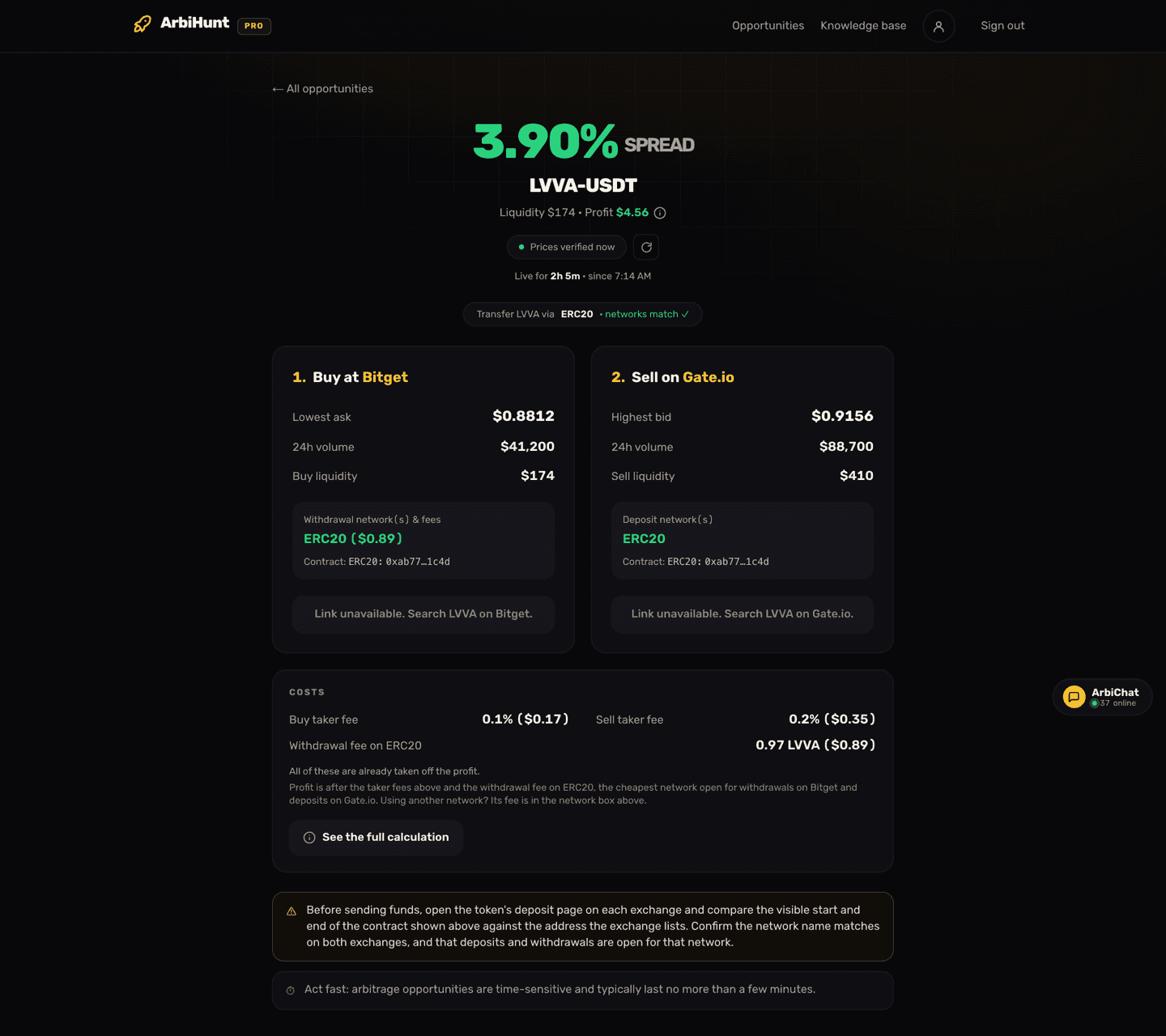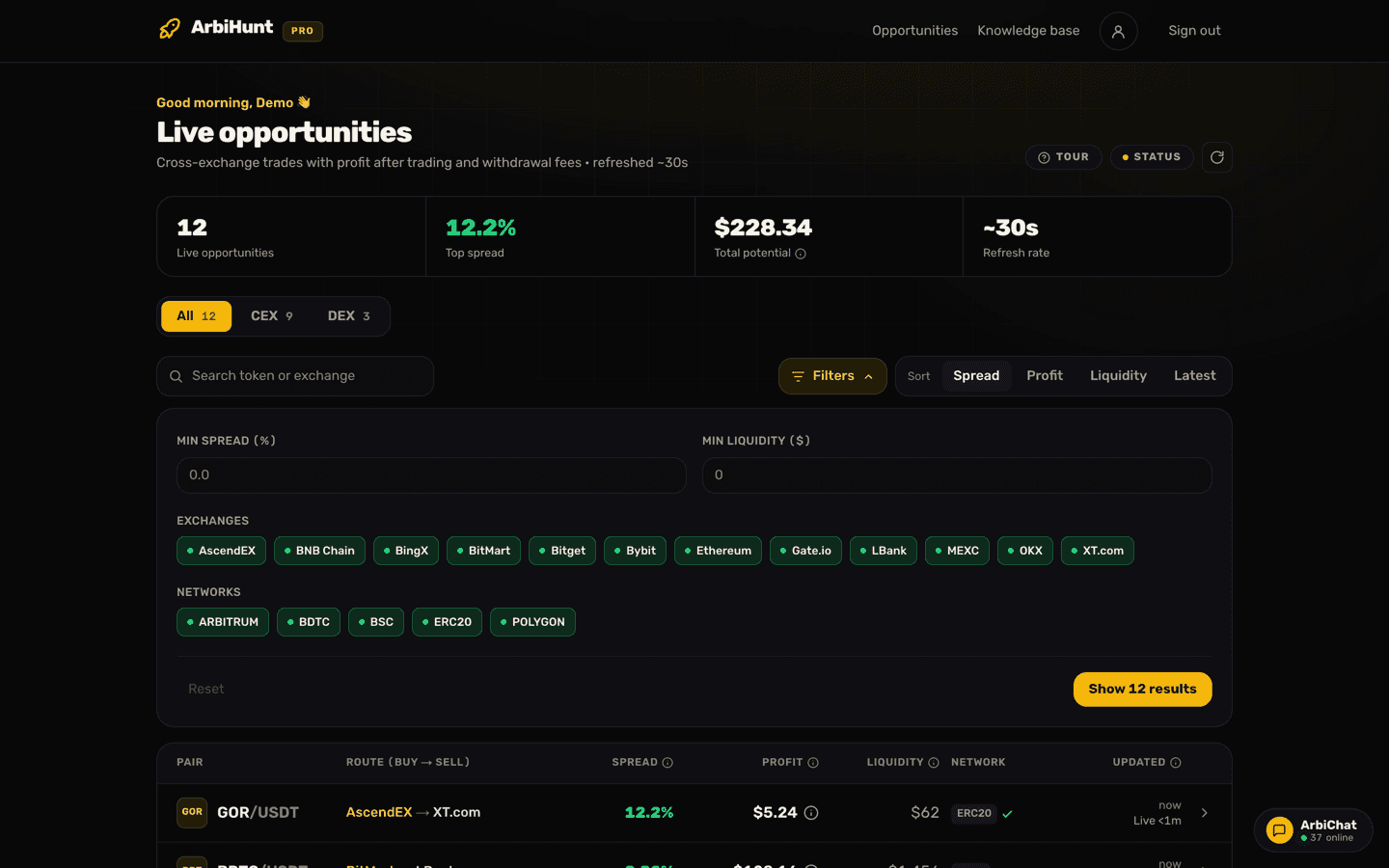
An arbitrage spread is a countdown. ArbiHunt's opportunity screen says so on every trade it shows: these windows are time-sensitive and typically last no more than a few minutes. A cross-exchange transfer can easily outlast the gap.
The unhelpful answer to "how long does a crypto transfer take" is it depends. The useful answer is that a transfer is not one wait. It is three, stacked back to back, and only one of them is the blockchain, usually the shortest of the three, a minute or two on a fast chain and around half an hour on Bitcoin. The two either side of it belong to the exchanges, and neither has a published limit.
The three clocks between buying and selling
Move a coin from Exchange A to Exchange B and you queue behind three processes:
- Withdrawal processing on the sending exchange. You click withdraw; nothing has touched the blockchain yet. The exchange still has to approve the request, sign it and broadcast it. This clock has no fixed length and no public schedule.
- Confirmations on the chain. Once broadcast, the transaction has to be included in a block, then buried under enough further blocks that the receiver treats it as final.
- Crediting on the receiving exchange. The receiver watches the chain, waits for its own required confirmations, then credits your balance and makes it tradable.
Only clock two is governed by the network. Clocks one and three are business decisions made by two companies, and that is where most waiting happens.
Why the exchange is usually the slow part, not the chain
People blame congestion. More often the transaction was sitting on a compliance desk.
- Manual and risk review is real. A larger-than-usual amount, a new account, a first withdrawal to an address, or an internally flagged coin can park a withdrawal in a queue for a human. You get "Processing" and no explanation.
- Security cooldowns. Many exchanges impose a fixed hold after a password change, a new 2FA device, or a newly added withdrawal address. Its length is that exchange's policy, and no support ticket shortens it.
- Per-coin, per-network suspensions. Withdrawals are toggled off constantly for wallet maintenance, chain upgrades and node problems. Normal, usually brief, invisible until you try.
- Batching. Some venues sweep withdrawals on an interval rather than broadcasting each one immediately, adding a wait unrelated to block time.
None of these have a published SLA. A plan that depends on a fast withdrawal is a plan that depends on luck.
The window closes while you are in flight
If you start moving funds only after spotting a spread, you are betting the price holds while your coins are in transit. On a 3% gross spread with $500 committed, a taker fee of 0.05% buying and 0.2% selling, and a $0.02 withdrawal fee, you net about $13.70, an edge wiped out by an adverse move of roughly 2.7% on the sell venue before you get there. Minutes of transfer time are minutes of that exposure. No spread is guaranteed.
How many confirmations does a chain actually need?
"Confirmations" means blocks mined on top of the one containing your transaction. Every receiver picks its own number, weighing the cost of a chain reorganisation against how long it can make you wait.
ArbiHunt makes exactly this decision for its own crypto payments. Pay for PRO from your own wallet and these are the depths waited for before access is granted, alongside the window for the transfer to land:
| Network | Confirmations | Block interval | Payment window |
|---|---|---|---|
| Bitcoin | 3 | ~10 minutes | 90 minutes |
| Ethereum (ETH and ERC-20) | 12 | ~12 seconds | 60 min, 30 for native ETH |
| BNB Smart Chain (BEP-20) | 15 | a few seconds | 60 minutes |
| Tron (TRC-20) | 20 | a few seconds | 60 minutes |
Multiply the middle two columns and the chain clock stops being mysterious. Three Bitcoin confirmations is roughly half an hour; twelve on Ethereum is two or three minutes; twenty on Tron is about one. That is the whole of clock two: everything else you wait for is an exchange.
It also kills a common misconception. A bigger confirmation count does not mean a longer wait. Tron is asked for nearly seven times the confirmations Bitcoin is, yet Bitcoin gets the longest window, because Bitcoin blocks are slow and Tron blocks are fast. Confirmations are depth, not time.
Exchanges tend to require more confirmations than a payment processor does, because a wrongly credited deposit on a venue with instant trading is far worse. Take the number your exchange quotes and do the same multiplication.
That is the real argument for caring which chain you use, on top of the fee argument. See choosing the right network for how to pick one both venues support, and withdrawal fees explained for what each route costs.
Reading the route before you commit
The opportunity detail screen puts the transfer decision in front of you before you touch an exchange.
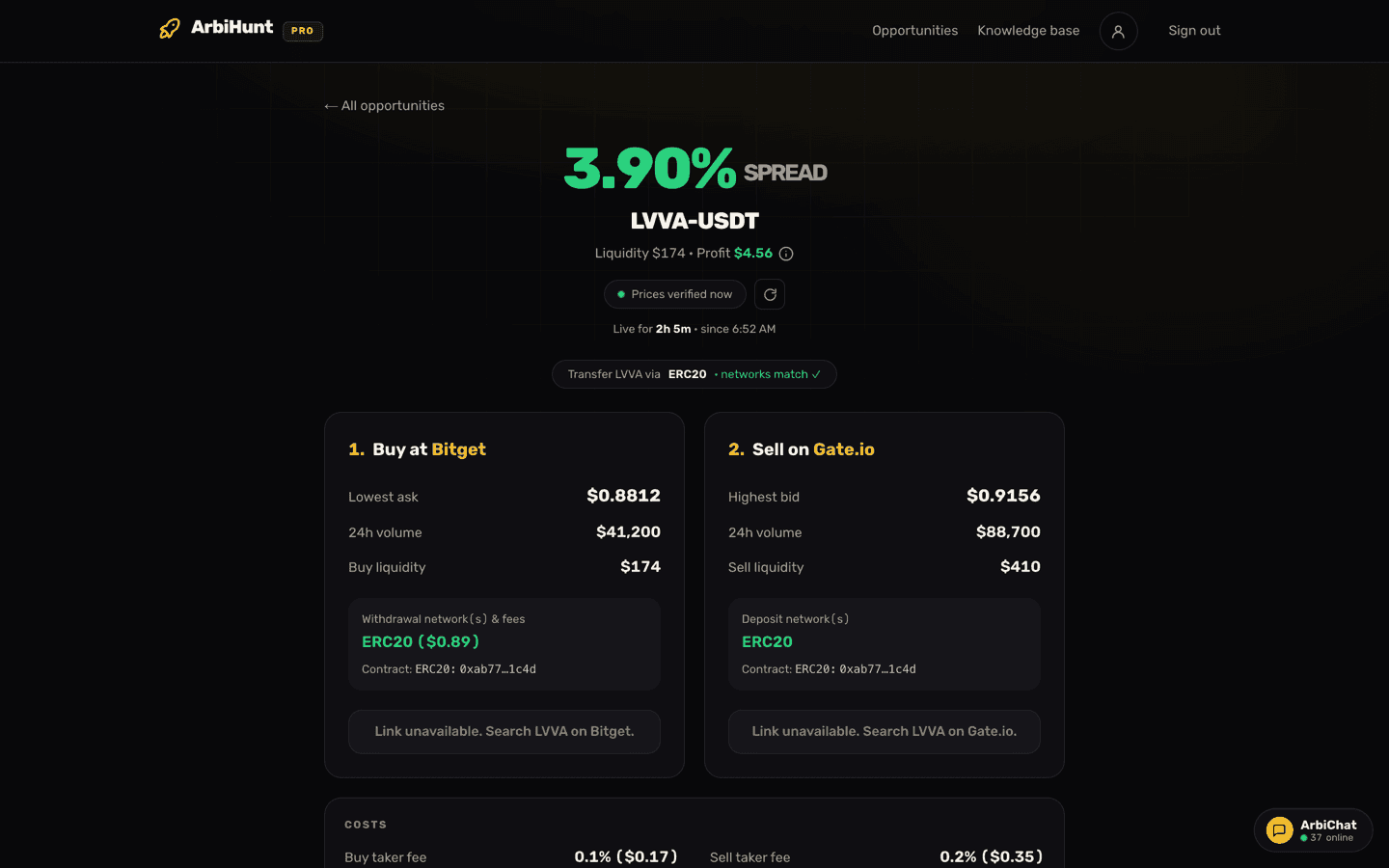
Three things on it decide your transfer, all visible before you spend:
- The transfer pill. It names the chain you would move the coin over and shows a "networks match" tick when the buy venue's withdrawal networks and the sell venue's deposit networks overlap. No match, no trade.
- Withdrawal network(s) and fees, on the buy leg. The fee is flat and per network, so it decides whether a small position is worth doing.
- Deposit network(s), on the sell leg: what the receiver will actually credit.
What the numbers cover: the headline percentage is the spread, the raw gap before any cost, and ArbiHunt's profit is after the taker fee on both legs and the withdrawal fee on the network the pill names, and the Costs card says so. What they cannot cover is time: a cheap chain that confirms slowly can still cost you the gap. The free arbitrage calculator reworks the fees at your own size, and returns the breakeven spread. Spread vs. net profit walks the whole cost stack.
Checking deposit and withdrawal health on the status page
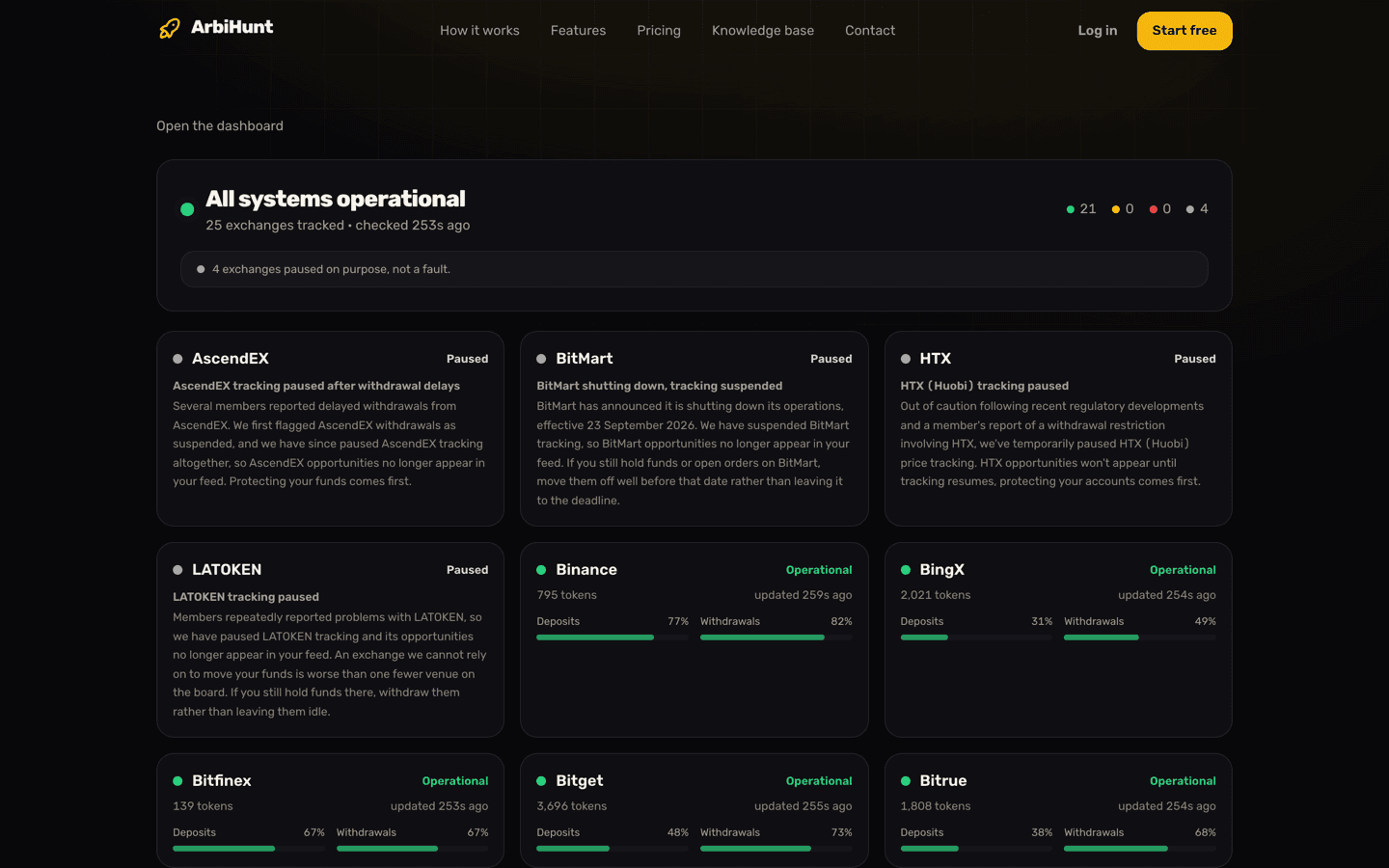
The public status page is the pre-trade check most people skip. It gives all 25 tracked exchanges a state (Operational, Degraded, Down, or Paused), and for every venue it is still tracking, the card also carries:
- How many tokens that exchange lists, and when its data was last updated ("updated 259s ago").
- A Deposits bar and a Withdrawals bar: the share of that exchange's listed tokens whose deposits or withdrawals are currently open. In one capture Binance sat at 77% deposits and 82% withdrawals across 795 tokens, while BingX showed 31% and 49% across 2,021.
Those percentages are a health signal, not a guarantee about your coin. An exchange at 82% still has hundreds of tokens with withdrawals closed, and yours might be one of them. Use the bar to judge the venue, not the route.
The states are worth knowing precisely. Degraded means the venue's data has fallen meaningfully behind the freshest exchange on the board, or its withdrawals have been flagged; Down means it has fallen a long way behind, or has not reported for hours. Paused is deliberate and is not a fault: ArbiHunt stops tracking a venue when there is reason to distrust moving funds through it, and its opportunities leave the feed entirely. Venues sit paused for reasons like members reporting delayed withdrawals, and one is paused because the exchange announced it is winding down. A paused card drops the token count, the timestamp and the bars, and prints that reason instead.
There is a middle state too: prices keep flowing while the withdrawal bar reads Suspended, and the page tells you plainly to avoid buying there to move funds out.
Status is a snapshot, the exchange is the source of truth
Health can change between the last check and your click. Before you send anything, open the coin's deposit and withdrawal pages on both exchanges and confirm the network is open on each. Check the contract address too: the same ticker can be a different, migrated or wrapped token on another venue. ArbiHunt shows the contract per exchange on the detail page for PRO.
Pre-funding: taking the clock out of the trade
The reliable way to beat transfer time is to not transfer during the trade.
Pre-funding means holding a balance on both exchanges in advance. When a spread appears you buy on one and sell on the other close to simultaneously, then rebalance later, with no countdown running. The slow transfer still happens; it just stops being on the critical path.
Be honest about what it costs. Capital is tied up across several venues instead of working in one place, and a balance left on an exchange carries that exchange's risk: pauses happen, and one venue on the board is paused because it is shutting down. So do not spread idle funds across venues you would not choose deliberately. Rebalancing is still a transfer with the same three clocks, but doing it off the clock lets you pick the cheap network instead of the fast one.
See the spread while it is still live
ArbiHunt scans 26 exchanges and about 15,000 markets roughly every 30 seconds, with the profit on every row after trading and withdrawal fees. Trades with a spread of 2% or more are PRO.
What to do when a transfer is stuck
Work out which of the three clocks you are stuck on. The answer decides who can help.
No transaction ID yet. Nothing is on-chain, so the sending exchange is holding the withdrawal and no explorer or ticket at the far end will change that. Check your email and the exchange's app for an unconfirmed approval link, a 2FA prompt, or a review notice, then open a ticket with that exchange. Do not submit a second withdrawal because the first looks stalled; you will often end up sending twice.
You have a transaction ID. Paste it into that chain's block explorer. If confirmations are climbing, the system is working and you are waiting out clock two. If the explorer has never seen it, the broadcast failed or has not happened yet, which is again a question for the sender.
Confirmed on-chain, not credited. Now it belongs to the receiving exchange. Usually the deposit is below that venue's minimum, the network is not one it credits at that address, a required memo or tag was omitted, or the token is a different contract from the one it lists. Open a ticket with the transaction ID, the exact network name, the amount and the timestamp. Recovery is manual, not always possible, and sometimes charged for.
In all three cases the trade is already over. Treat the recovery as a separate problem, and do not chase the spread with more capital while the first transfer is in limbo. The risks of crypto arbitrage covers the other failure modes worth planning for.
The short version
- Three clocks, not one: withdrawal processing, chain confirmations, deposit crediting. The two exchange clocks are the long, unpredictable ones.
- Confirmations are depth, not time. Multiply the count by the chain's block interval before calling a route fast.
- Check the status page, then the exchange itself. A high withdrawals percentage is a good sign about the venue, not a promise about your coin.
- Pre-fund both sides to trade 10-to-15-minute spreads, and rebalance when nothing is on the line.
- ArbiHunt never touches your funds. Every order, withdrawal and deposit is yours to place: how to execute an arbitrage trade, step by step is the full sequence, and how to read the dashboard explains the columns you judge it from.
Figures shown here are live snapshots and may have moved by the time you act. Re-check inside your exchange before transacting. This is not financial advice, and crypto trading carries risk.
See it live
ArbiHunt scans 26 exchanges in real time and ranks every spread by true net profit, after fees, withdrawals and live liquidity.