"Arbitrage" is not one strategy. It is a family, and the members share almost nothing except the starting idea: the same value priced inconsistently in two places at the same moment. What separates them is where the inconsistency lives and what it costs to reach it.
Below are the five you will actually run into: the mechanics, what each genuinely requires, and who it suits. ArbiHunt covers one in full and part of another, and this article says plainly which.
Which types of crypto arbitrage are there?
| Type | Where the gap lives | Realistically needs |
|---|---|---|
| Cross-exchange (spatial) | One coin, two exchanges | 2+ funded accounts, patience |
| Triangular | Three pairs, one exchange | An execution bot |
| Statistical | Two correlated assets over time | Data, backtests, risk budget |
| Funding-rate | Spot vs. perpetual futures | Margin literacy, hedged capital |
| Cross-chain / DEX-CEX | A liquidity pool vs. an order book | A wallet, gas, on-chain skill |
Only the first is comfortably manual. The rest all pay their edge to whoever is fastest, best capitalised, or willing to carry risk overnight.
Cross-exchange (spatial) arbitrage
This is the version most people mean by "crypto arbitrage": a coin trades cheaper on one exchange than another at the same moment, so you buy where it is cheap, move or already hold the coin on the other side, sell where it is expensive, and keep whatever survives the costs.
The gap exists because there is no consolidated crypto price. Every exchange runs its own isolated order book, and nothing forces Exchange A to agree with Exchange B except traders moving capital, which happens slowly. What is crypto arbitrage? walks through the full mechanics.
The arithmetic on a cross-exchange trade
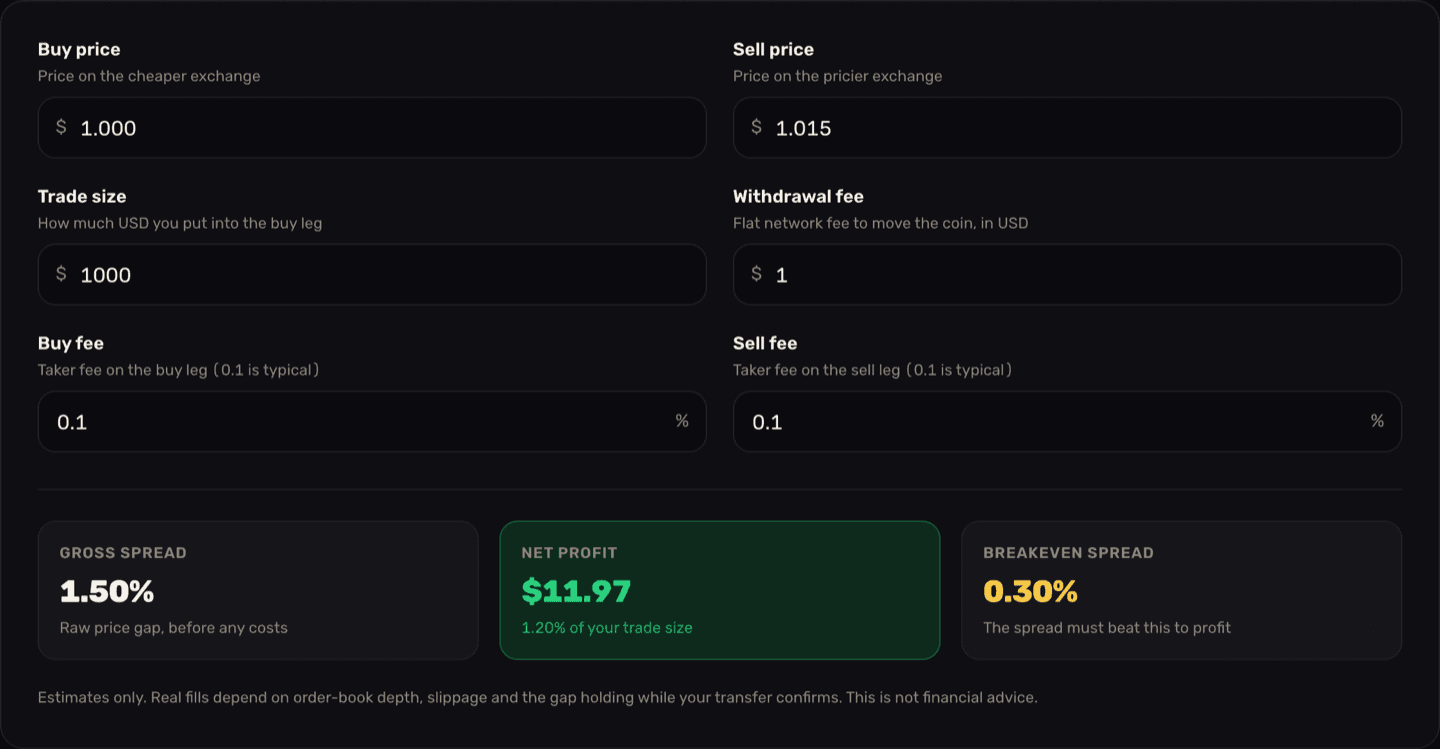
A 3% gross spread is not a 3% trade. Say you commit $200 to a token showing a 3% gap, with 0.1% taker fees on both venues and a flat $2 withdrawal fee to move the coin:
- Taker fees: 0.1% + 0.1% = 0.2%
- Withdrawal fee: $2 on $200 = 1.0%
- What is left: 3% − 1.2% = 1.8%, or about $3.60
Now run the same trade at $2,000. The flat $2 fee is only 0.1%, so you keep about 2.7%. Flat fees do not scale down, which is why the same spread is a real trade at one size and a waste of a click at another. Spread vs. net profit takes that gap apart line by line.
What cross-exchange really needs
Two or more funded exchange accounts, verified and able to withdraw. Either the patience to wait out a transfer, or enough capital to pre-position balances on both venues and rebalance later. No servers, no API keys, no code.
The cross-exchange trade-offs
- Transfer time. A transfer takes minutes to hours, and the spread can close while your coins are in flight, leaving you holding a token you did not want at a price you did not choose.
- Network compatibility. The coin's network must be open for withdrawal on the sending exchange and deposit on the receiving one. Sending on a network the destination does not credit is one of the few ways to lose funds outright, so read Choosing the right network first.
- Same-ticker, different asset. Two coins sharing a symbol are not automatically the same token: contracts get migrated, wrapped, or reused by unrelated projects.
Verify the contract before you move funds
ArbiHunt shows the contract address on both legs (a PRO feature on the opportunity detail page), and marks a route with a shared transfer network, so you can confirm both venues mean the same coin before you withdraw anything. Check it every time.
This is the one ArbiHunt scans in full
ArbiHunt watches 26 exchanges across roughly 15,000 markets and refreshes about every 30 seconds. It prices each opportunity from executable order-book levels, the lowest ask on the buy venue against the highest bid on the sell venue, not a mid-price ticker, and shows beside every spread what the trade leaves you after every fee, so the headline gap is never the whole story.
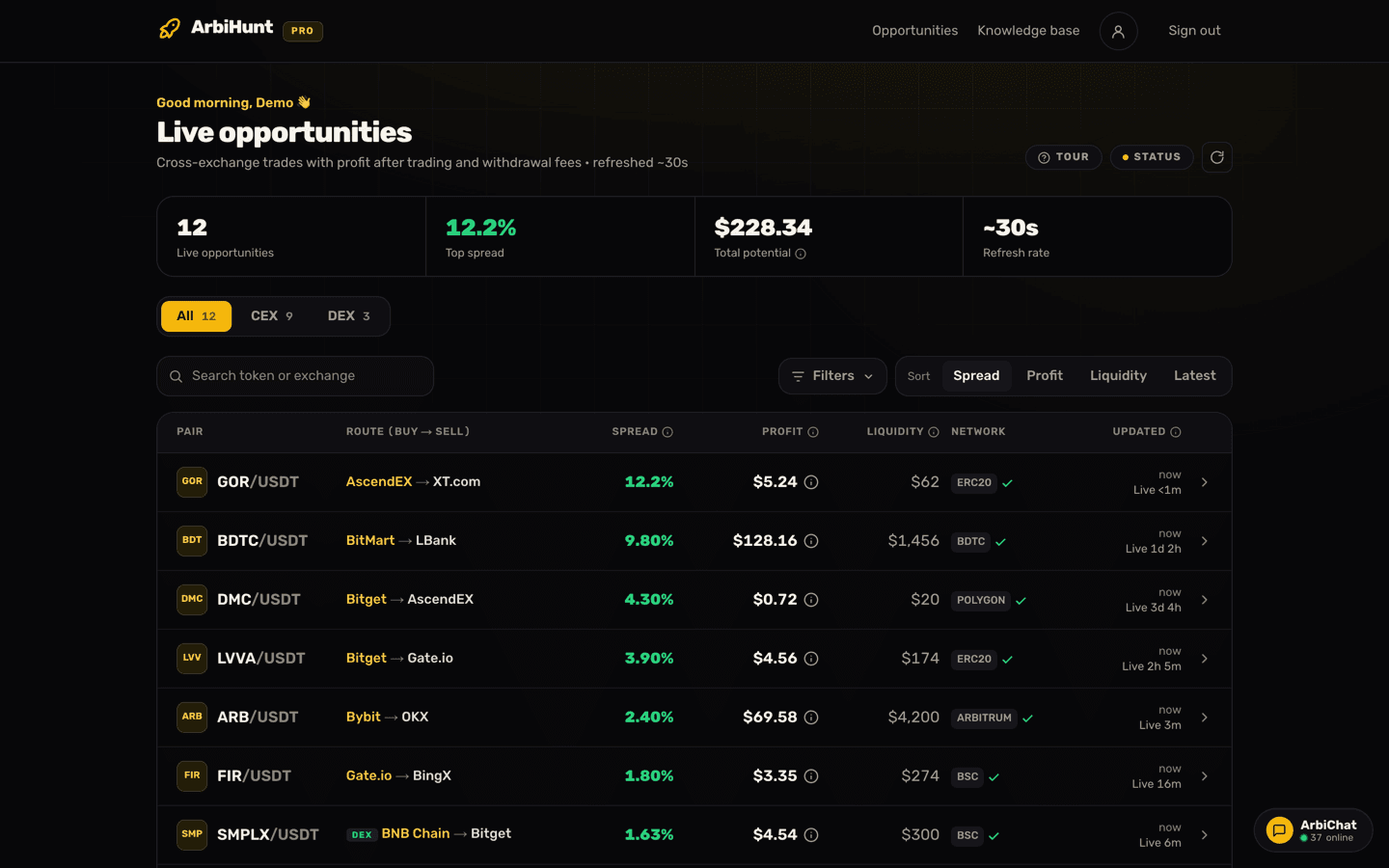
What those numbers cover: the % on every row is the spread, the raw gap before any cost, and the profit beside it is after the taker fee on both legs, on-book liquidity and the exchange withdrawal fee on the cheapest network open on both sides, and trades that would lose money after that fee are not listed. The opportunity detail page lists each cost, and PRO members can tap the (i) to see every step. Where an exchange gives no withdrawal fee we can confirm, nothing is deducted and the page says so. On a small position, that fee is the largest single cost, so a trade much smaller than the row keeps less than a proportional share.
Exchanges can also be paused deliberately, usually after withdrawal problems: paused venues drop out of the feed and are labelled on the status page, because a spread you cannot transfer across is not an opportunity.
Triangular arbitrage
Triangular arbitrage never leaves a single exchange. You convert around a loop of three pairs, say USDT into BTC, BTC into ETH, ETH back into USDT, and if the quoted rates do not line up you finish with slightly more than you started.
No withdrawal, no transfer, no network to match, which removes a whole category of risk and replaces it with a harder one: speed.
The arithmetic on a triangular loop
Three conversions means three fills, and three taker fees. At 0.1% per fill you pay 0.3% just to complete the loop. So a 0.4% pricing inconsistency, which is already large for a liquid triangle, leaves 0.1%. On $1,000 that is a dollar, assuming all three legs fill at the price you saw.
They usually do not. These loops are closed in fractions of a second by bots reading the same books you are, and if one leg slips the loop finishes negative while you are still clicking.
What triangular really needs
Automated execution against the exchange's API, with all three orders fired together, plus a maker-fee tier or fee rebate to have any margin at all. Hand-trading a triangle is not a smaller version of this strategy, it is a different and losing one. This is software territory: Arbitrage bot vs. scanner is an honest look at what that automation costs you in API-key risk and control.
ArbiHunt does not scan for triangular opportunities. It compares one coin across venues, not three pairs within one.
Statistical arbitrage
Statistical arbitrage drops the "same asset in two places" requirement entirely. You find two assets whose prices have historically moved together, and when the relationship stretches unusually wide you buy the laggard and short the leader, betting the gap narrows back.
It is on this list mainly so you can tell it apart: cross-exchange and triangular arbitrage capture a gap that exists right now; this is a bet on a relationship reverting.
What statistical arbitrage really needs
Clean historical data, a backtesting framework, position sizing that survives a drawdown, and shorting or margin on at least one leg. Also the discipline to accept that a correlation which held for two years can break in a week, usually the week you are in the trade.
This one is not risk-free arbitrage
A spread that is unusually wide can keep widening, and no arbitrage-style mechanism forces it shut. This is a quantitative trading strategy with real directional risk, not a variant of buying low on one exchange and selling high on another.
ArbiHunt does not scan for statistical arbitrage. Nothing on the board is a mean-reversion signal.
Funding-rate (spot vs. perpetual) arbitrage
This one lives in derivatives. A perpetual futures contract tracks spot without ever expiring, anchored by a funding rate: a periodic payment between longs and shorts, typically every eight hours, that pushes the contract price back toward spot.
A delta-neutral trader holds the coin on spot and an offsetting short perpetual of the same size. Price moves cancel out between the legs, and the return is the funding stream rather than a one-off spread.
The arithmetic on a funding trade
Funding is quoted per interval. A rate of 0.01% paid three times a day is 0.03% a day, which compounds out near 11% a year, before trading fees and before the rate changes. Rates move constantly and can go negative, at which point the position pays out instead of collecting.
What funding arbitrage really needs
Capital tied up on both legs at once, plus margin headroom so a sharp move in the coin does not liquidate the short before the hedge does its job. Leverage introduces a failure mode spot arbitrage simply does not have. It also needs continuous attention: this is a position you hold, not a trade you finish.
ArbiHunt does not track funding rates or perpetuals. It is a spot scanner.
Cross-chain and DEX-CEX arbitrage
The last family puts one leg on-chain. Either the same token is priced differently in a decentralised exchange pool than on a centralised order book, or it is priced differently on two chains and you bridge between them.
The mechanics look familiar, buy the cheap side and sell the expensive one, but the cost structure is unrecognisable. Instead of taker fees and a withdrawal fee you pay gas on every transaction, pool swap fees, slippage that grows with your swap size relative to the pool, and on a cross-chain route bridge fees and waiting time. A transaction that reverts still costs the gas.
What on-chain arbitrage really needs
A self-custody wallet you can operate confidently, tolerance for gas burned on failed transactions, and an understanding that your pending transaction is visible to others before it confirms, which is how profitable on-chain trades get front-run. Cross-chain adds bridge risk on top, historically one of the most exploited parts of the ecosystem. If none of that is routine yet, the centralised version teaches the same economics with fewer ways to lose the position outright, and the risks of crypto arbitrage covers what still goes wrong there.
ArbiHunt covers the DEX-CEX half, not bridges. Alongside the exchange routes, the board lists trades with one leg in a DEX pool, quoted through KyberSwap on BNB Chain, Ethereum, Base or Arbitrum, or through Jupiter on Solana, and the other on a centralised exchange, with the coin moving between them on that same chain. They are marked DEX, priced for one trade size, and you swap from your own wallet. Routes that need a bridge between chains are not scanned.
Which type should you start with?
Cross-exchange. It is the only member of the family where a person, rather than a program, can still see the opportunity, check it and decide. The route, the network, the fees and the liquidity are all inspectable before you commit a cent, so your first mistakes are cheap and legible instead of automated.
Test the arithmetic on your own assumptions with the free arbitrage calculator first, then work through how to execute an arbitrage trade once a route looks worth acting on.
See the full board
ArbiHunt scans 26 exchanges every ~30 seconds and ranks cross-exchange spot routes by profit after trading and withdrawal fees. Free accounts see every route; PRO unlocks trades with a spread of 2%+, the dollar figure with its calculation, and the filters.
Whichever family you explore, keep the boundary clear: ArbiHunt is an information tool. It never connects to your exchange accounts, never asks for API keys, never holds funds and never places a trade: you trade on the exchanges yourself. Spreads close in seconds, so re-checking the live numbers on the venue before you commit is not optional. None of this is financial advice, and crypto trading carries a real risk of loss.
See it live
ArbiHunt scans 26 exchanges in real time and ranks every spread by true net profit, after fees, withdrawals and live liquidity.