Crypto arbitrage is buying a coin on the exchange where it happens to be cheap, selling it on the exchange where it happens to be expensive, and keeping the difference after costs.
It works because there is no single world price for a crypto asset. Every exchange runs its own order book, those books drift apart constantly, and when they drift far enough the same token really is worth more on one venue than another, for a while.
Two things to get straight before anything else. The gap you see quoted, the spread, is not your profit: fees, transfer costs and shallow order books all take a bite, and on a small trade they can take the whole thing. And these gaps are ordinary rather than spectacular, often only a percent or two. Anyone advertising a fixed daily return from arbitrage is selling something.
How does crypto arbitrage work?
Every cross-exchange trade has the same two legs, buy low on one venue and sell high on another. The only real question is how the coin gets from the first to the second.
- The transfer route. Buy on the cheap exchange, withdraw the coin over a blockchain network to the expensive exchange, sell it there. Easy to picture, but the transfer takes minutes to hours and the price can move while your coins are in flight.
- The pre-funded route. Keep balances waiting on both exchanges: stablecoins on one, the coin on the other. When a gap opens you buy on one side and sell on the other almost simultaneously, then rebalance later. Much faster, but it ties up capital on several venues.
Either way the arithmetic is identical: sale proceeds, minus what you paid, minus every fee in between. If that number is positive at a size the order books can actually absorb, the opportunity is real.
Why do price gaps exist between crypto exchanges at all?
In US equities these gaps have largely been competed away: every venue quotes against one consolidated national best bid and offer. Crypto has no such thing, and its market structure keeps producing gaps in four ways.
- Liquidity is fragmented. Hundreds of exchanges each run an isolated book. Nothing forces one venue's price to match another's except traders moving capital between them, and capital moves slowly.
- Listings are uneven. A mid-cap token might trade on six of the 26 exchanges ArbiHunt scans and nowhere else. Fewer shared participants means looser price linkage, and a fresh listing is often mispriced for hours.
- The user bases are different. Exchanges serve different countries, currencies and trading cultures, so a wave of local buying shows up on local venues first. The Korean "kimchi premium" is the famous version; the same effect runs quietly on smaller regional venues.
- Moving coins costs money and time. Closing a gap means withdrawing from one venue and depositing on another, which costs a network fee and takes anywhere from a minute to a day. When that round trip costs more than the gap is worth, nobody bothers and the gap just sits there, and when an exchange suspends withdrawals for a coin, it cannot be closed at all, which is why ArbiHunt publishes per-exchange deposit and withdrawal health.
Who closes the gaps, and how fast?
Arbitrage traders close them, simply by trading. Every buy on the cheap venue consumes its lowest asks and lifts the price; every sell on the expensive venue eats its highest bids and lowers it. The books walk toward each other until what is left is not worth the fees, which is why arbitrage is generally considered useful rather than predatory.
Speed depends on who is watching. A gap on BTC between two major exchanges is closed in seconds by professional firms, and no manual trader will beat them to it. A gap on a mid-cap coin listed on four venues can stay open for minutes, because far fewer people are looking. That is the window a scanner is for: ArbiHunt re-checks roughly 15,000 markets about every 30 seconds and stamps each row with how long ago it was verified.
What does a real board of live opportunities look like?
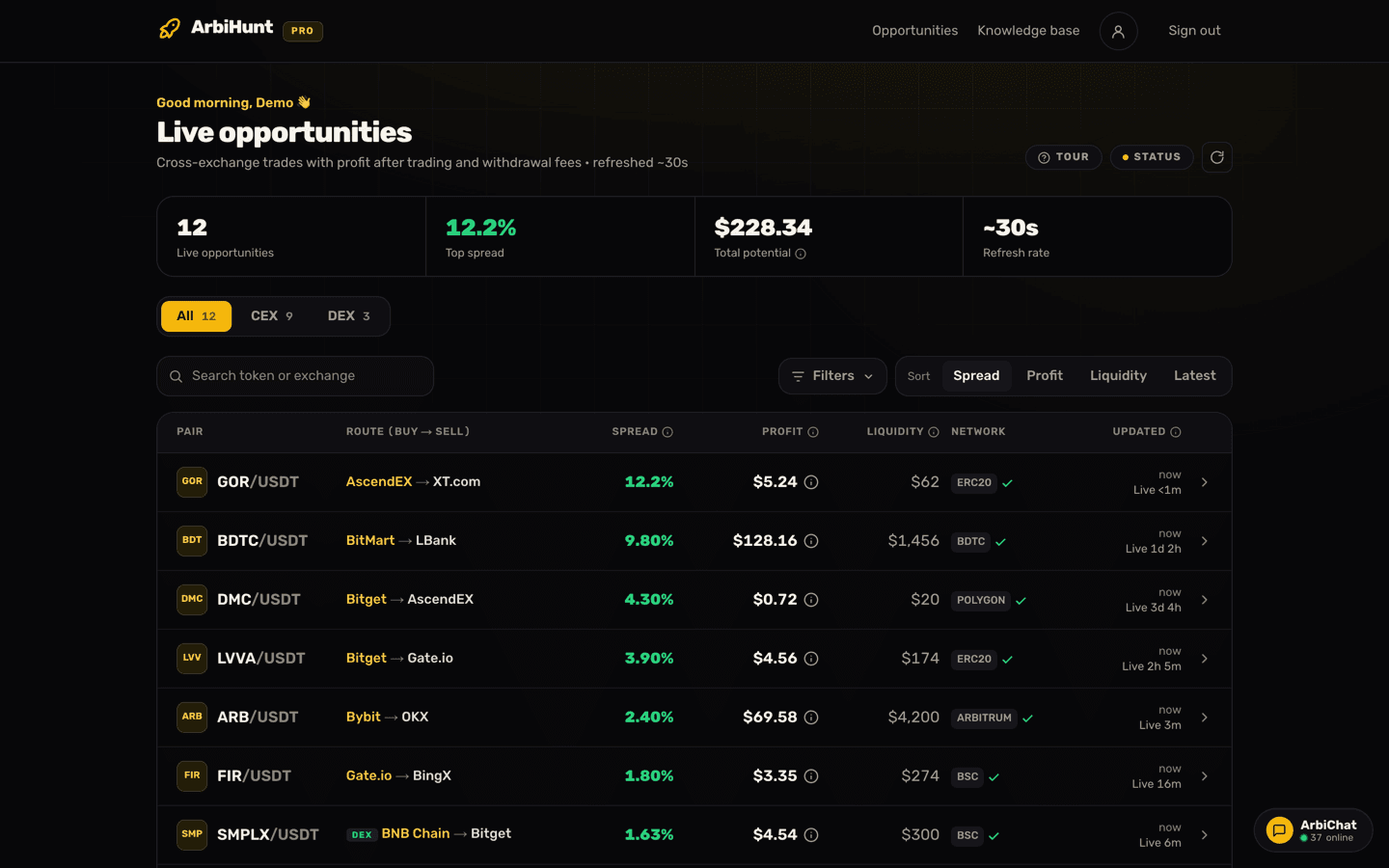
The screenshot at the top of this article shows the board with example rows, so read it for the layout rather than the numbers. Every row is one trade: a coin, the exchange to buy on, the exchange to sell on, and what the trade leaves you. The percentage is the spread, the raw price gap between the two exchanges before any cost, and live it is usually small: most rows sit under 2%, and the few far above that tend to sit on very thin books. That shape is normal: arbitrage is a business of small, frequent, unglamorous gaps.
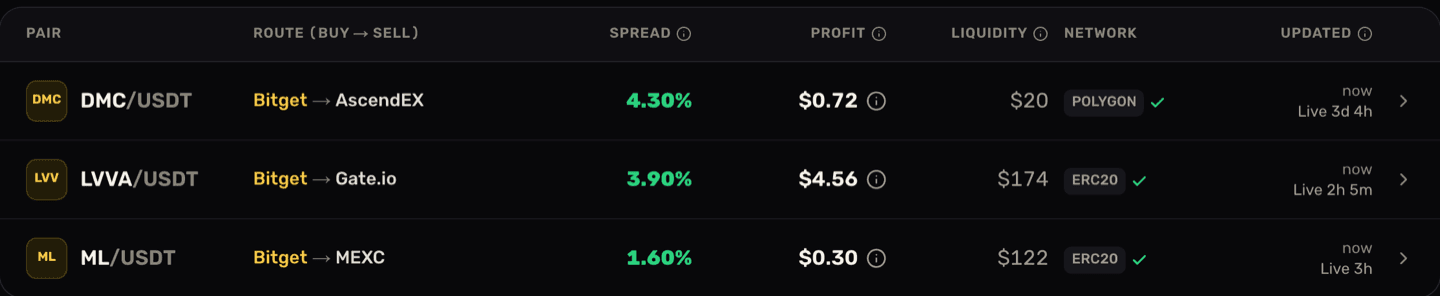
Reading those three columns together is the habit to build early. Spread is the raw price gap before costs. Profit is what the trade is worth in dollars once the trading fees and the withdrawal fee are out and the size is capped by the books. Liquidity is how much you can move before the price slips away from you.
What does one arbitrage trade look like with real numbers?
Percentages hide the traps, so here is a full trade at a spread you would actually see on the board.
A token shows a best ask of $0.1000 on Exchange A and a best bid of $0.1024 on Exchange B at the same instant: a 2.4% gross spread. Both venues charge a 0.10% taker fee, and Exchange A charges a flat withdrawal fee of 20 tokens. You commit $500.
- Buy leg. 5,000 tokens at $0.1000 costs $500.00. The 0.10% taker fee adds $0.50, so your outlay is $500.50.
- Transfer. The flat 20-token fee comes off the top, so 4,980 tokens arrive at Exchange B. At the sell price that fee cost about $2.05.
- Sell leg. 4,980 tokens at $0.1024 brings $509.95. The 0.10% taker fee takes $0.51, leaving $509.44.
Net result: $8.94, about 1.8% net on the capital committed. A 2.4% gross spread handed back roughly a quarter of itself, and that was with cheap fees and a modest withdrawal charge.
Now run the identical trade with $100. You buy 1,000 tokens for $100.10 including the fee, the flat 20-token withdrawal fee still applies so only 980 arrive, and selling them nets $100.25. Profit: $0.15, about 0.15%.
Same coin, same spread, same moment, and the edge has all but vanished. Flat withdrawal fees do not shrink with your position, which is why a "great" spread on a tiny trade is often not worth the click.
The spread is the bait, not the take-home
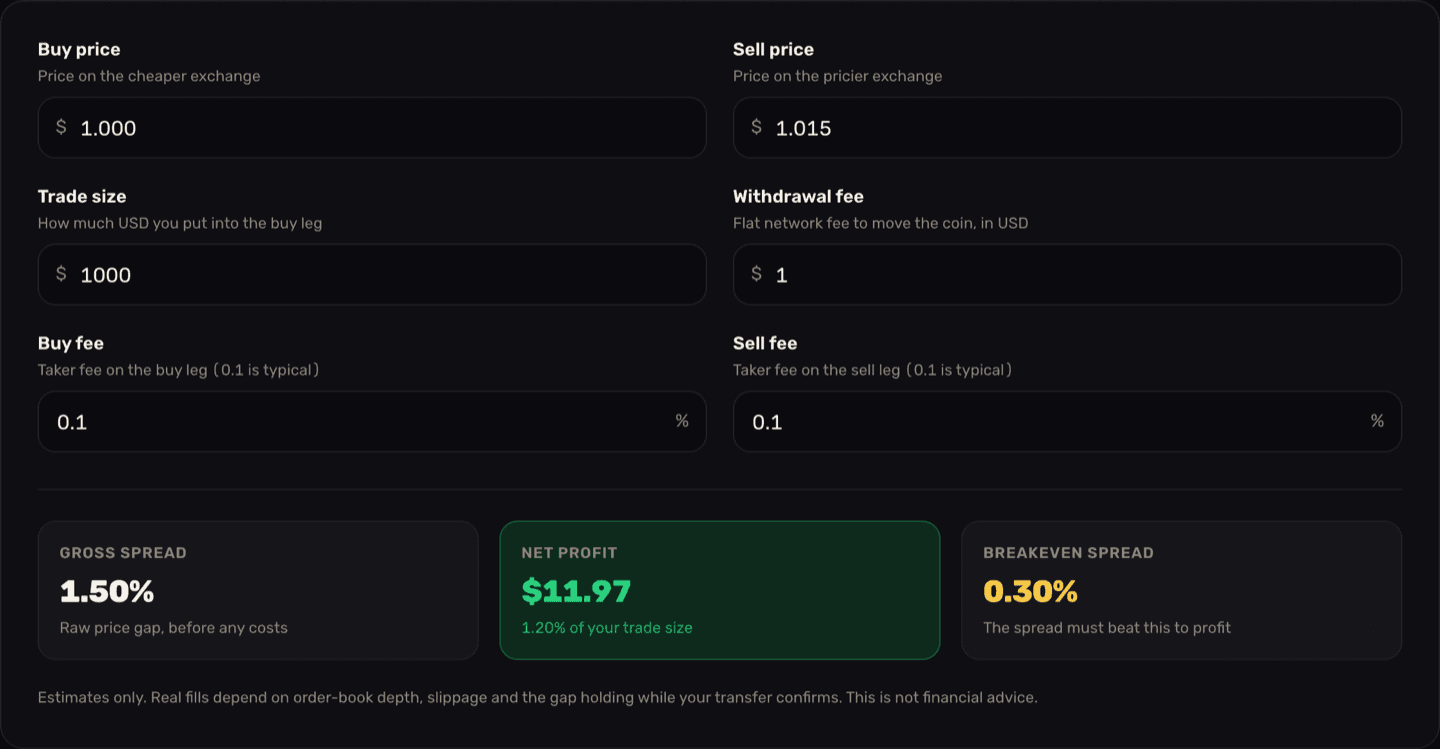
A gap only matters after taker fees on both legs, the transfer fee, and the slippage you eat when your order is larger than the resting depth. Act on the net number, never the raw gap.Spread vs. net profit prices each of those costs in turn, and the free arbitrage calculator works out the gross spread, net profit and breakeven spread for your own prices, size and fees.
One last trap: that $0.1024 bid has a size. If only 2,000 tokens of buying interest sit there and the next bid down is $0.1010, a 5,000-token market sell fills the rest worse, and your 2.4% was never 2.4% at your size. Price an opportunity from live order-book depth, not a single ticker.
What makes a spread actually tradeable?
Four things have to hold at once.
- It is the same asset on both venues. A shared ticker guarantees nothing; the contract address has to match, on a network both exchanges support.
- The route is open. If the cheap exchange has suspended withdrawals for that coin, or the expensive one is not accepting deposits, the spread is decoration.
- There is enough depth for your size. Judge the trade against the liquidity resting in both books, not the headline price.
- The profit survives every fee. Taker fees on both legs plus the transfer cost, exactly as in the worked example.
Checking that by hand across two dozen venues is the tedious part, and it is what ArbiHunt automates: it watches 26 exchanges continuously, prices each opportunity from executable order-book prices rather than a mid-price ticker, and shows what each trade is worth after trading fees and the withdrawal fee. A trade that would lose money after those costs is not listed. A venue with withdrawal problems can be paused on purpose, dropping out of the feed until it is trustworthy again.
What the profit figure includes
ArbiHunt's profit is after the taker fee on both legs and the exchange withdrawal fee on the cheapest network open on both sides, and caps the trade at the liquidity actually on the books. The % beside it is the spread, the raw gap before any of those costs. PRO members can tap the (i) beside any profit to see every step. When an exchange gives no withdrawal fee we can confirm, nothing is deducted for it and the detail page says so, so check that fee yourself.Free accounts get the whole live feed. Trades with a spread of 2% or more are PRO: a free account still sees the route, spread, liquidity and network on those rows, with the coin name blurred, but tapping one opens the upgrade prompt instead of the opportunity's detail page and its links out to both exchanges. The profit in dollars on exchange rows, filters and sorting are PRO on every row.
See it live
ArbiHunt watches 26 exchanges and roughly 15,000 markets, refreshes about every 30 seconds, and prices every trade at what it is worth after taker fees, the withdrawal fee and real on-book liquidity.
What are the main types of crypto arbitrage?
Arbitrage is a family of strategies rather than one trade. Cross-exchange (spatial) arbitrage, the same coin priced differently on two venues, is the beginner-friendly kind, the subject of this article, and the type ArbiHunt scans for. Triangular and funding-rate arbitrage are the other two common forms, and both are tighter, faster and riskier than they look. Types of crypto arbitrage covers when each applies and what it costs you.
Is crypto arbitrage legal?
In most places, yes. It is ordinary buying and selling on public markets, and exchanges have no rule against it. Two caveats: profits are normally taxable, and in some countries every crypto-to-crypto trade is a taxable event, so keep records of both legs; and some countries restrict which exchanges residents may use. Check your local rules first. None of this is financial or tax advice.
Is crypto arbitrage risky?
Yes. It removes the bet on where a coin is heading and replaces it with execution risk. The spread can close while your transfer is confirming. A withdrawal can be delayed or suspended mid-trade, stranding your capital on the wrong exchange. A thin book can slip your fill. And two coins sharing a ticker can be entirely different assets on different chains.
Same ticker, different coin
Compare the contract address on both exchanges before you move funds, and confirm the network name matches on both sides. A matching symbol guarantees nothing.The risks of crypto arbitrage lists every failure mode with a mitigation for each. Spreads can close in seconds, not every displayed opportunity is executable, and none of this is financial advice.
How much money do you need to start?
There is no formal minimum, but the arithmetic punishes tiny positions: the same spread above paid 1.8% at $500 and 0.15% at $100, entirely because of a flat withdrawal fee. Start small enough that a mistake is cheap, and scale only once the process feels boring. How to execute an arbitrage trade walks a first trade through from account setup to the final sell.
Do you need a bot to trade arbitrage?
No. Bots matter for the seconds-long gaps on major pairs, a contest already settled by firms with faster infrastructure than any retail bot will have. Manual traders do better on the wider, slower spreads on mid-cap coins, where a scanner finds and verifies and you make the call. Arbitrage bot vs. scanner covers the trade-off, including the API-key risk a bot introduces.
How much can you realistically make?
It depends on volatility, your capital and how fast you execute, and anybody quoting a fixed daily return is selling you something. Volatile days produce more chances; on calm days the board is nearly empty. Is crypto arbitrage profitable? works through what is realistically left after costs. Returns are never guaranteed.
Does ArbiHunt trade for me?
No, and that is deliberate. ArbiHunt is a scanner, not a bot. It finds, verifies and ranks opportunities; you place both legs yourself on your own exchange accounts. It never connects to those accounts, never asks for API keys or a wallet connection, and never holds your funds. Full custody and the final call stay with you.