For some people, yes. For a lot of people, no, and they find out one withdrawal fee at a time.
The price gaps between exchanges are real and they appear every day. Whether you can turn one into money comes down to four things you mostly settle before you ever open a scanner: how much capital you can put behind a single trade, which exchanges you can actually trade on, how fast you can move, and how many hours a week you are willing to give it.
This is the arithmetic, not the pitch. If you get to the end and decide arbitrage is not for you, that is a good outcome, and it cost you ten minutes instead of a year.
Where the profit comes from, and what stands in front of it
Cross-exchange arbitrage means buying a coin where it is cheap and selling it where it is expensive. What is crypto arbitrage? covers the mechanics. The gaps exist because every exchange runs its own order book and capital cannot teleport between them.
The catch is that a spread is not a profit. Three costs sit in between:
- Two taker fees. You pay to buy and again to sell. Around 0.1% per leg on most venues, so roughly 0.2% of your trade size gone before anything happens.
- One flat withdrawal fee to move the coin from the buy exchange to the sell exchange. Flat, denominated in the coin, not a percentage. This is the cost that decides everything below.
- Slippage, whenever your order is larger than the depth sitting at the quoted price.
Your capital size matters more than your skill
The withdrawal fee does not care how big your trade is. That single property is why the same opportunity, at the same second, is a loss for one person and a good afternoon for another.
Take one concrete trade: a 1.2% gap, a 0.1% taker fee on each leg, and a $5 withdrawal fee to move the coin across. Nothing changes except how much you put in.
| Trade size | Net profit | Spread needed to break even |
|---|---|---|
| $200 | -$3.00 | 2.71% |
| $500 | -$0.01 | 1.20% |
| $1,000 | +$4.98 | 0.70% |
| $5,000 | +$44.89 | 0.30% |
| $20,000 | +$194.54 | 0.23% |
Same coin, same two exchanges, same instant. At $200 you pay for the privilege of trading. At $500 you do all the work for a rounding error. At $20,000 the fee is background noise.
Two things follow, and they are really the whole article:
- Below roughly $500 to $1,000 per trade, most opportunities are unprofitable no matter how sharp you are. That is not a skill gap you can close with practice. It is subtraction.
- Your breakeven spread is personal. Someone trading $20,000 clears at 0.23%. You at $500 need 1.20% for the identical trade. You are looking at the same board and playing a different game.
The withdrawal fee is not fixed, either, which cuts both ways. Move that same $1,000 trade onto a network charging $15 instead of $5 and it flips from +$4.98 to -$5.02. Withdrawal fees and networks explained has the per-network numbers and why the same coin can cost cents on one chain and double digits on another.
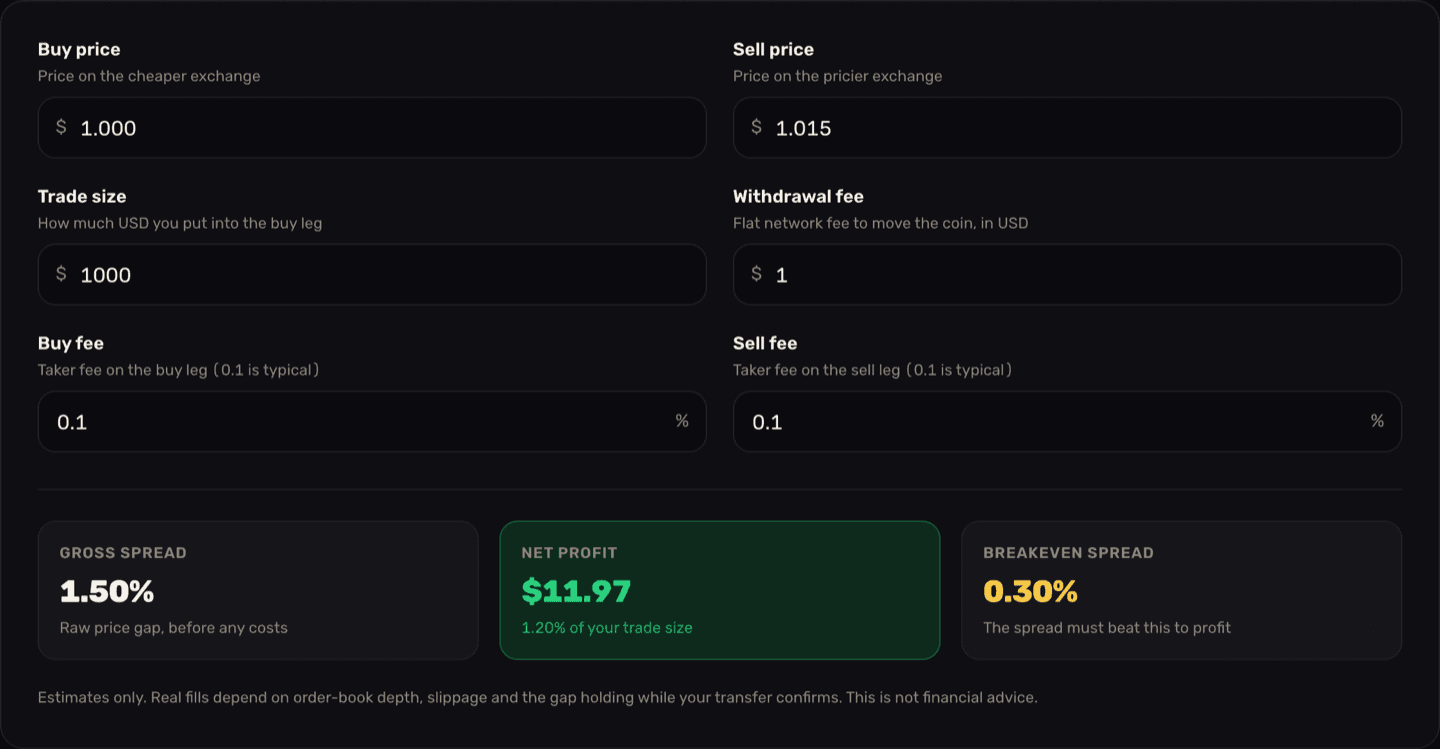
Every row of that table came out of the free arbitrage calculator, which needs no account and sends nothing anywhere.
The profit on the board already includes the withdrawal fee
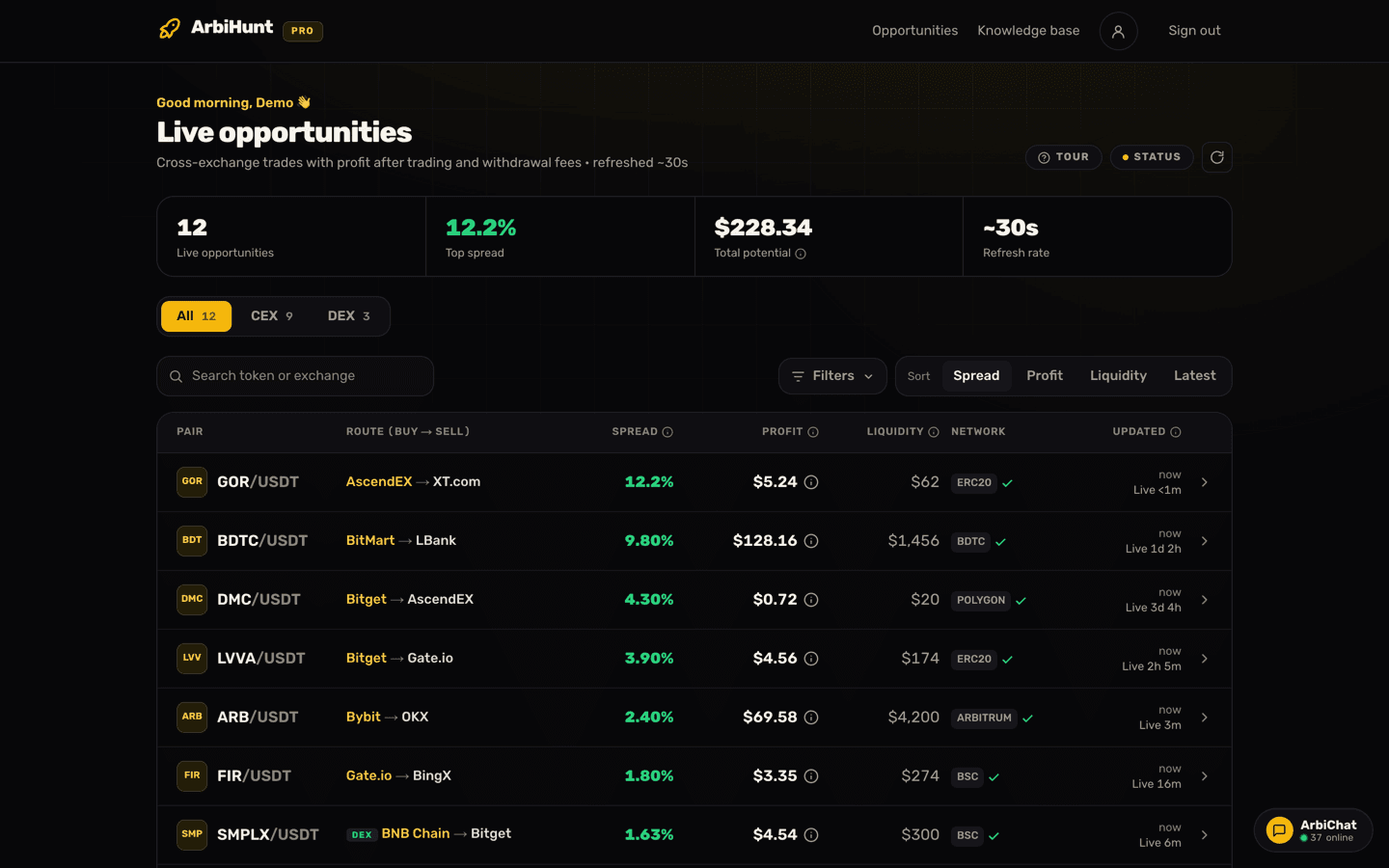
The % on every row is the spread, the raw gap between the two prices before any cost. The profit beside it is computed from executable order-book prices (the lowest ask on the buy venue against the highest bid on the sell venue, walked through the real depth behind the quote), after the taker fee on both legs and the exchange withdrawal fee on the cheapest network open on both sides. Trades that would lose money after that fee are not listed. It is still measured at the size the books could take: trade smaller and the flat fee weighs more, which is exactly why your breakeven is personal. When an exchange gives no fee we can confirm, nothing is deducted and the opportunity page says so. Spread vs. net profit walks the whole stack.
How many opportunities you can actually take
ArbiHunt watches 26 exchanges and roughly 15,000 markets, refreshed about every 30 seconds. You can only act on the ones where you hold a verified, funded account on both ends. If you are set up on three exchanges, most of the board is a spectator sport.
That pulls in an uncomfortable direction. The widest gaps cluster on smaller, newer coins and smaller venues, precisely because those markets are slower to track the rest of the world. The accounts that would add the most opportunities to your list are the ones you should trust with the least capital and the shortest holding time.
Availability moves under you, too. Deposits and withdrawals for a specific coin or network get paused constantly, and ArbiHunt suspends tracking on a venue outright when withdrawals stop being reliable, so a paused exchange drops out of the feed rather than handing you trades you cannot exit. Per-exchange deposit and withdrawal health is public on the status page. A spread you can buy into but not withdraw out of is not an opportunity. It is a bag.
Speed: the window can close at any moment
The board refreshes about every 30 seconds, and every opportunity page carries the same warning: they are time-sensitive and typically last no more than a few minutes.
So the obvious sequence, spot the spread, buy, withdraw, wait for confirmations, deposit, sell, usually loses. By the time the coin lands, the gap that justified the trade has closed and you are just a person holding a small-cap token.
People who make this work pre-fund both sides. They keep inventory on both exchanges, sell on the expensive one and buy on the cheap one within the same few minutes, and rebalance later on their own schedule, when transfer time is not costing them the trade. Deposit and withdrawal times explains why the wait is the core risk.
Pre-funding is not free either. It means capital parked on exchanges you do not control, exposed to whatever it is parked in and to the venue itself. No fee schedule lists that cost, and it belongs in your math anyway.
Check the math before you commit capital
ArbiHunt does the fee, depth and network work on 26 exchanges every ~30 seconds so you can judge an opportunity in seconds instead of tab-hopping. You still place every trade yourself.
What is the realistic ceiling?
There is no honest average return, and any site quoting you one is selling something. You can bound it yourself, though.
Start with the hard cap: each opportunity is limited by its liquidity, the dollar depth behind it, shown on every row. A 9% spread with $60 of depth is a $60 trade, and a large order into a thin book walks the price against you until the edge is gone.
So your ceiling is the size you can deploy per trade, times the trades you can genuinely execute in a day, minus everything you cannot take for the reasons above. Nobody else can quote you that number.
The ways people actually lose money
- Trading too small. The single most common one, and the table above is the whole explanation.
- Same ticker, different asset. A symbol on one exchange can be a different, migrated or wrapped contract than the identical symbol on another. Sending the wrong one is usually unrecoverable. ArbiHunt shows the contract address on both legs, a PRO feature, so you can compare them against each exchange's own deposit page before anything moves.
- Network mismatch. The sending exchange supports a network the receiving one does not. Confirm the network is open on both ends, for that coin, before you withdraw.
- Getting stuck. You buy, then discover withdrawals for that coin are disabled. Now you are holding a directional position you never wanted.
- Chasing the top of the board. The biggest percentage is usually the thinnest, newest and least withdrawable row on the screen. It looks like the best opportunity and is often the worst.
The risks of crypto arbitrage goes through the failure modes properly, and how to execute an arbitrage trade is the checklist version for when you decide to do one.
So, is it for you?
Probably not, if you are working with a few hundred dollars, can only trade on one or two big exchanges, check in once a day, or need a predictable amount by a specific date. Those costs are structural.
Possibly, if you can commit meaningful size per trade, have verified accounts on several venues including a couple of mid-sized ones, and can act inside a fifteen-minute window while you are at a screen.
Either way it is a grind: small percentages on real capital, repeated, and one careless transfer erases a lot of them.
What ArbiHunt does, and what it deliberately does not
ArbiHunt is an information tool. It never connects to your exchange accounts, never asks for API keys, never holds funds and never places a trade. You place every order yourself, on the exchange, with your own login. That is a limitation on purpose, and arbitrage bot vs. scanner explains the trade-off.
A free account sees the live feed across all 26 exchanges and every opportunity with a spread under 2% unblurred: coin, route, spread, liquidity, network, detail page and the links out to both exchanges. Opportunities with a spread of 2% or more appear with the coin name blurred, and the dollar profit figure on exchange rows, its step-by-step calculation and the filters are PRO. That runs $8.99 a week, $19.99 a month or $125.99 a year, plus a $224.99 one-off Lifetime tier if you pay in crypto.
Do the same math here: at $19.99 a month, PRO has to earn you about $20 a month more than free does. At $200 a trade it will not. At $5,000 a trade, one opportunity covers a year of it.
None of this is financial advice. Crypto trading carries real risk and you can lose money, including on trades that looked profitable on screen.
See it live
ArbiHunt scans 26 exchanges in real time and ranks every spread by true net profit, after fees, withdrawals and live liquidity.