Bots and scanners chase the same thing: a coin priced differently on two exchanges. They differ in one place, and it is not accuracy or coverage. It is who presses the button. A bot holds keys to your exchange accounts and presses it for you. A scanner does the finding and the arithmetic, then hands you a screen and stops.
That decides the rest: what you can reach in a second, and what you can lose in a night. The short answer: a scanner suits almost anyone not already running automation as a system, and the rest of this article is the reasoning, including where a bot is genuinely the better tool. New to the strategy itself? Start with what crypto arbitrage is.
What does a crypto arbitrage bot actually do?
An arbitrage bot is software that watches prices and places the orders itself. You create API keys on each exchange, paste them into the bot, fund the accounts, set rules (minimum spread, maximum size, allowed coins) and step back. When a rule matches, capital moves with no human in the loop.
For that to work, the bot needs real reach into your money: at a minimum, keys with trading permission on every connected venue. Some setups also want withdrawal permission so the bot can move coins between exchanges itself, which is close to full control of the balance. Others skip transfers by pre-funding both venues and firing the two legs at once, which removes the transfer risk but ties up double the capital.
They range from open-source scripts you host yourself to cloud platforms with monthly fees. The common thread: the machine decides, the machine executes, and your funds are committed the instant a rule fires.
What does an arbitrage scanner do instead?
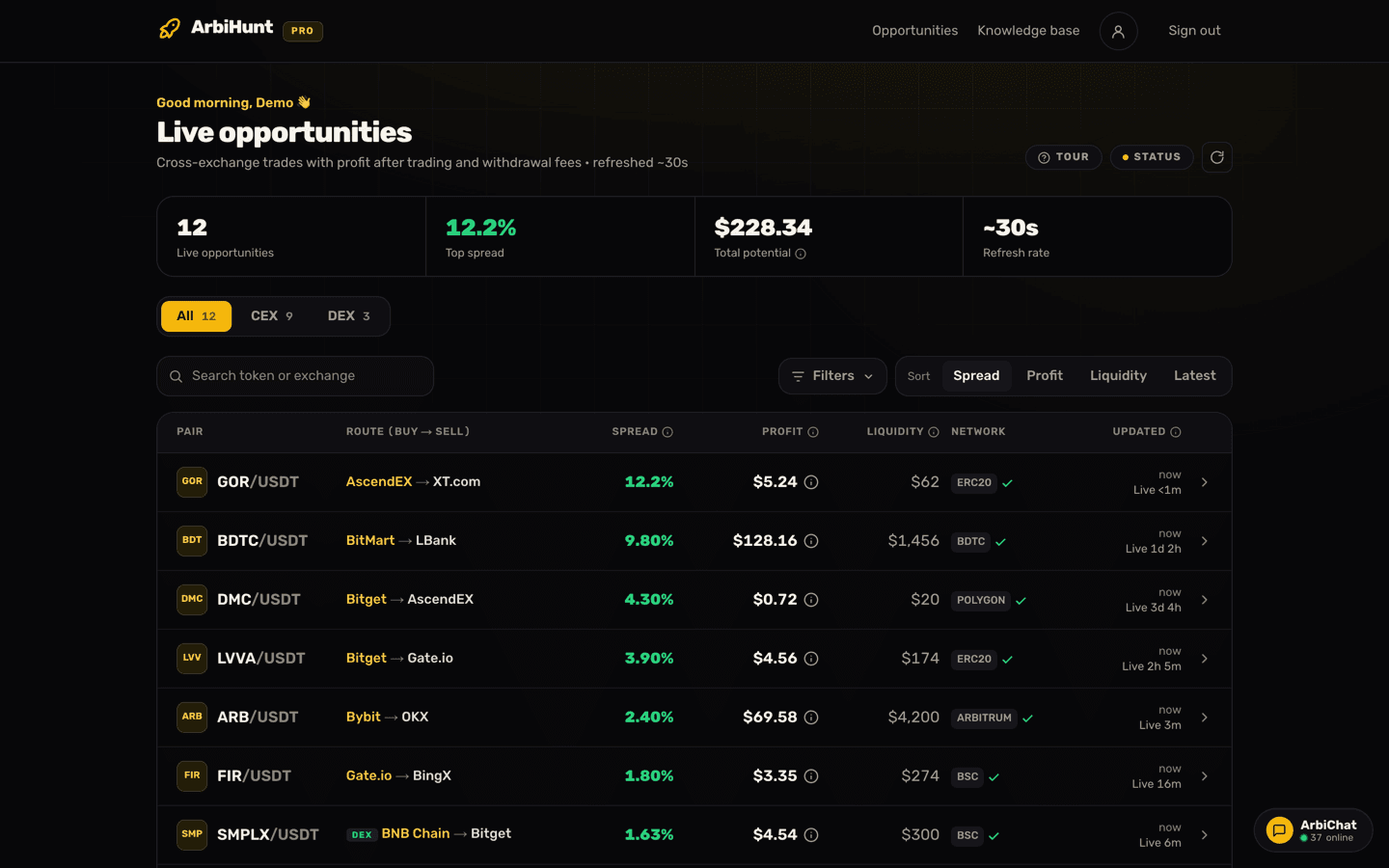
A scanner does the finding and the pricing, not the trading. It watches exchanges continuously, works out which gaps survive costs, ranks them and shows you the route. You decide whether to take it, and at what size.
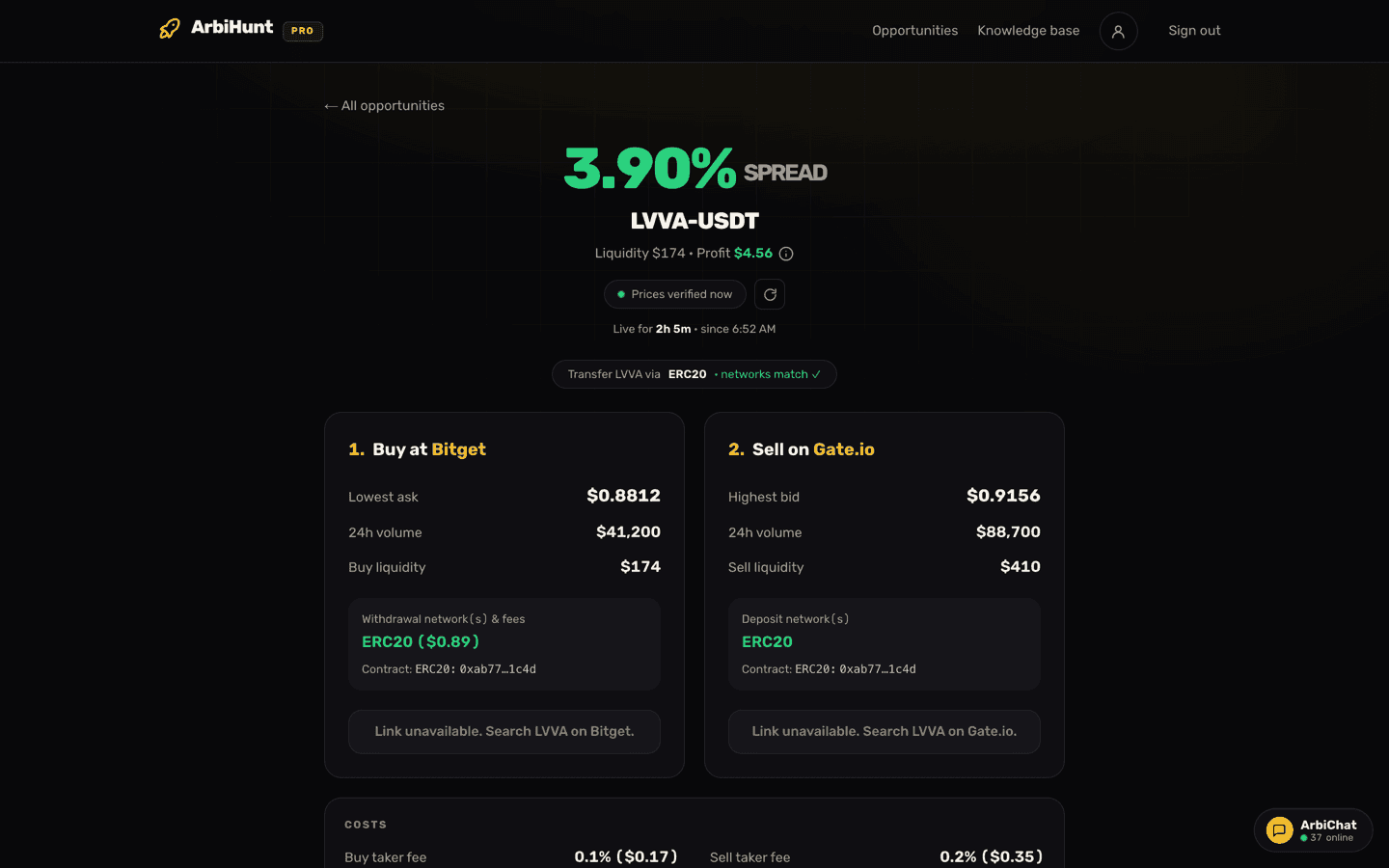
ArbiHunt is a scanner. It reads roughly 15,000 markets across 29 exchanges and refreshes about every 30 seconds. Each spread is priced from executable order-book prices, the lowest ask on the buy venue against the highest bid on the sell venue, never a mid-price ticker. The profit is after the taker fee on both legs, the depth actually on the books and the exchange withdrawal fee for moving the coin, and a trade that would lose money after that fee is not listed. The gap between the raw spread and that profit is the whole subject of spread vs net profit, and it is where most arbitrage maths goes wrong.
The scanner is read-only by construction. It works from public market data, so there is no key to paste, no wallet to connect, and nothing on ArbiHunt's side that could place an order even if it wanted to. Venues are sometimes paused on purpose, for instance after withdrawal problems, and drop out of the feed until they are trustworthy again; the exchange status page lists which and why.
Where does a bot genuinely beat a human?
Three places, and they are real advantages, not marketing.
- Reaction time. A bot acts in milliseconds. A gap that opens and closes inside two seconds is not a trade a person can take, ever.
- Coverage while you sleep. It watches every hour of the day without anyone at a screen.
- Consistency. A bot never talks itself into a bigger size after a good run, or hesitates on the one setup that met all its rules.
Anyone telling you a scanner is faster than a bot is selling something. The honest question is whether the gaps you can realistically trade need that speed.
What does a bot cost you in keys and custody?
Trading keys are a standing risk. They sit on someone else's server for as long as the bot is connected, and if that platform is breached, misconfigured or dishonest, they can churn your balance through fee-heavy trades or dump it into an illiquid book. Keys carrying withdrawal permission are a different category again: functionally that is custody of your funds by a party you cannot audit.
Execution risk gets automated too, and the costs are certain while the returns are not. Bots strand trades: the buy fills, the transfer sits unconfirmed, the gap closes, and the machine holds a coin bought for a spread that no longer exists. Every failure in the risks of crypto arbitrage still applies under automation, only faster, and at 3 a.m. nobody is awake to stop the second one. Meanwhile the subscription or the server bill runs whether or not the bot finds anything worth taking.
If you do run a bot, start with the key permissions
Create API keys with trading permission only, never withdrawal permission, and IP-allowlist them if the exchange supports it. A stranded trade costs you one spread. A leaked withdrawal-enabled key can cost you the account.Why is ArbiHunt a scanner and not a bot?
Three deliberate decisions.
Safety as structure, not as a promise. The moment a service holds trading keys for tens of thousands of users it becomes a target worth attacking, and no security page changes that. ArbiHunt has no field anywhere to paste an exchange key: you sign in with Google, Apple or a code emailed to you, and that account never touches an exchange. The worst a bug on our side can cost you is a missed opportunity.
Honesty about where a retail trader can win. The millisecond gaps that justify automation are contested by firms with better infrastructure than any subscription bot. What is left for everyone else is wider spreads on smaller books that stay open for minutes, and finding those is a data problem, not a speed problem. Reading 15,000 markets every 30 seconds is exactly that problem.
Judgment catches what rules miss. Arbitrage is full of edge cases a parameter cannot express: a token that is not quite the same asset on both chains, a venue with frozen withdrawals, a spread that exists because something is broken. A person reading the detail screen catches those. A rule matching on spread and depth does not.
See what the scanner hands you
ArbiHunt ranks live trades across 29 exchanges by profit after the taker fee on both legs and the withdrawal fee. No API keys, no funds, no orders.
How much speed does trading by hand really cost you?
Less than you would guess, because in cross-exchange arbitrage the clock that matters is not the order, it is the transfer. Buying takes seconds; moving the coin to the second venue takes minutes, and no bot shortens a blockchain confirmation or an exchange's deposit crediting. See deposit and withdrawal times for what those minutes look like per network.
That is why ArbiHunt's opportunity screen tells you these windows are time-sensitive and typically last no more than a few minutes, and stamps every detail page with when the prices were last verified. A gap alive for ten minutes does not care whether a human or a machine opened the buy.
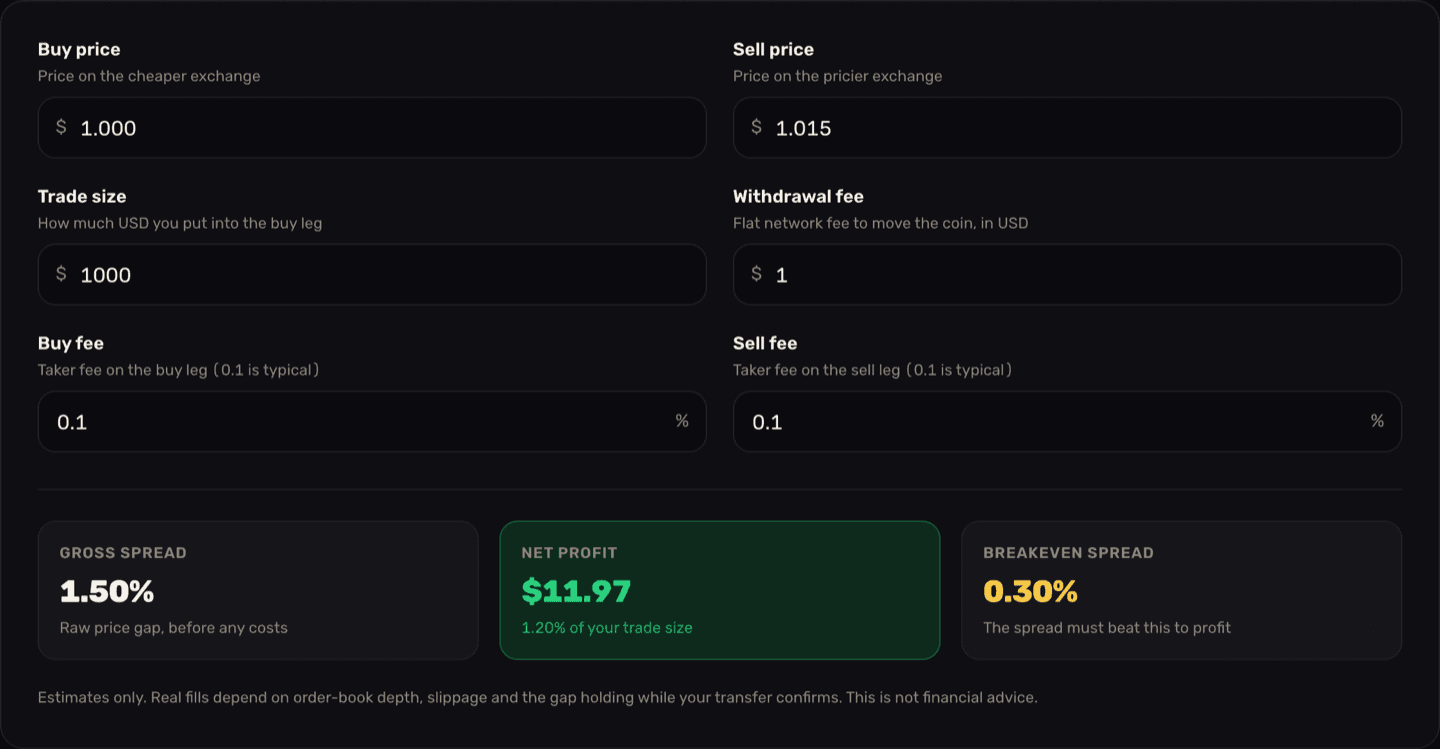
Work an example. Put $1,000 into a 3% gross gap: buy at $1.000, sell at $1.030, 0.1% taker fee on each leg, $2 to move the coin.
- The two fees take $2.03 and the transfer takes $2, leaving $25.94 net, or 2.59%
- Breakeven for that setup is a gross spread of 0.40%, so everything under that is a loss dressed as a win
Not one line of that arithmetic changes if a machine places the orders. Automation buys you a better chance that the $1.030 bid is still there when you arrive. But on a board where the top row carries $23 of depth, size caps you long before latency does. Run your own numbers in the arbitrage calculator.
Which one should you use?
A bot is defensible if you can read what it does, run keys without withdrawal permission, pre-fund both venues, size positions so a stranded leg is annoying rather than painful, and carry the subscription and server cost in your P&L. That is an experienced trader running automation as a system, not a beginner buying a money printer.
A scanner suits almost everyone else: anyone unwilling to hand trading keys to a third party, anyone still learning how spreads and transfers behave, anyone who wants to approve each trade before money moves. Work through the step-by-step execution guide, start small, and let the scanner search while you decide. The two are not opposites either: plenty of traders learn the terrain with a scanner first, then decide whether anything is worth automating.
Do arbitrage bots really make money?
Some do, in narrow conditions: well-audited setups run by people who understand the failure modes and count every cost. But any bot advertising a fixed daily return is a red flag. Real results swing with volatility and are never guaranteed, whoever or whatever places the order. Nothing here is financial advice, and neither tool can promise you a profit.
Can you use ArbiHunt together with a bot?
Not directly. ArbiHunt has no trading API and does not connect to bots, by design: every opportunity is meant to be read, checked and executed by you. Nothing stops you running automation separately on your own keys, but that stays on your side of the line.
Either way, a free account sees the live feed across all 29 exchanges, with every route, spread, liquidity figure, network and timestamp real. Trades with a spread of 2% or more show with the coin name hidden until you upgrade, and the profit in dollars on exchange rows, its calculation, filters and sorting are PRO features that free vs PRO sets out field by field.