ArbiHunt finds and ranks the spreads. You place both trades yourself, on the exchanges, with your own accounts and your own money. That one fact decides everything here: a 3% spread between two venues you have never signed up to is not an opportunity, it is a screenshot.
Setup turns the board from something you read into something you can act on. Here is the order.
A spread you cannot trade on is worth nothing
Every opportunity has two legs, the venue you buy on and the venue you sell on, and you need a verified, funded account on both. One out of two is zero.
ArbiHunt tracks 26 exchanges, 21 of which were live when this was written; the rest were paused on purpose, which we come back to below. Any two of those 21 make a route, so the board holds 210 pairings, and your account list decides how many you can reach.
| Accounts you hold | Routes you can reach | Share of the 210 pairings |
|---|---|---|
| 2 | 1 | under 1% |
| 4 | 6 | about 3% |
| 8 | 28 | about 13% |
| 12 | 66 | about 31% |
Going from four accounts to eight does not double your coverage, it more than quadruples it: each account you add pairs with every one you already hold.
Two caveats. Opportunities cluster on the venues listing the same thin tokens, so this is the geometry of coverage, not a forecast of trades. And every extra account is another identity file, another idle balance, another counterparty.
Which exchanges to open, and in what order
This guide will not rank exchanges, and ArbiHunt publishes no "best exchange" list: such rankings age badly, and they cannot know what matters to you. Use your own board instead.
- Start with two. Take one small trade all the way through, buy, transfer, sell, before you open a third. The point is not the profit; it is learning how long your withdrawal genuinely takes.
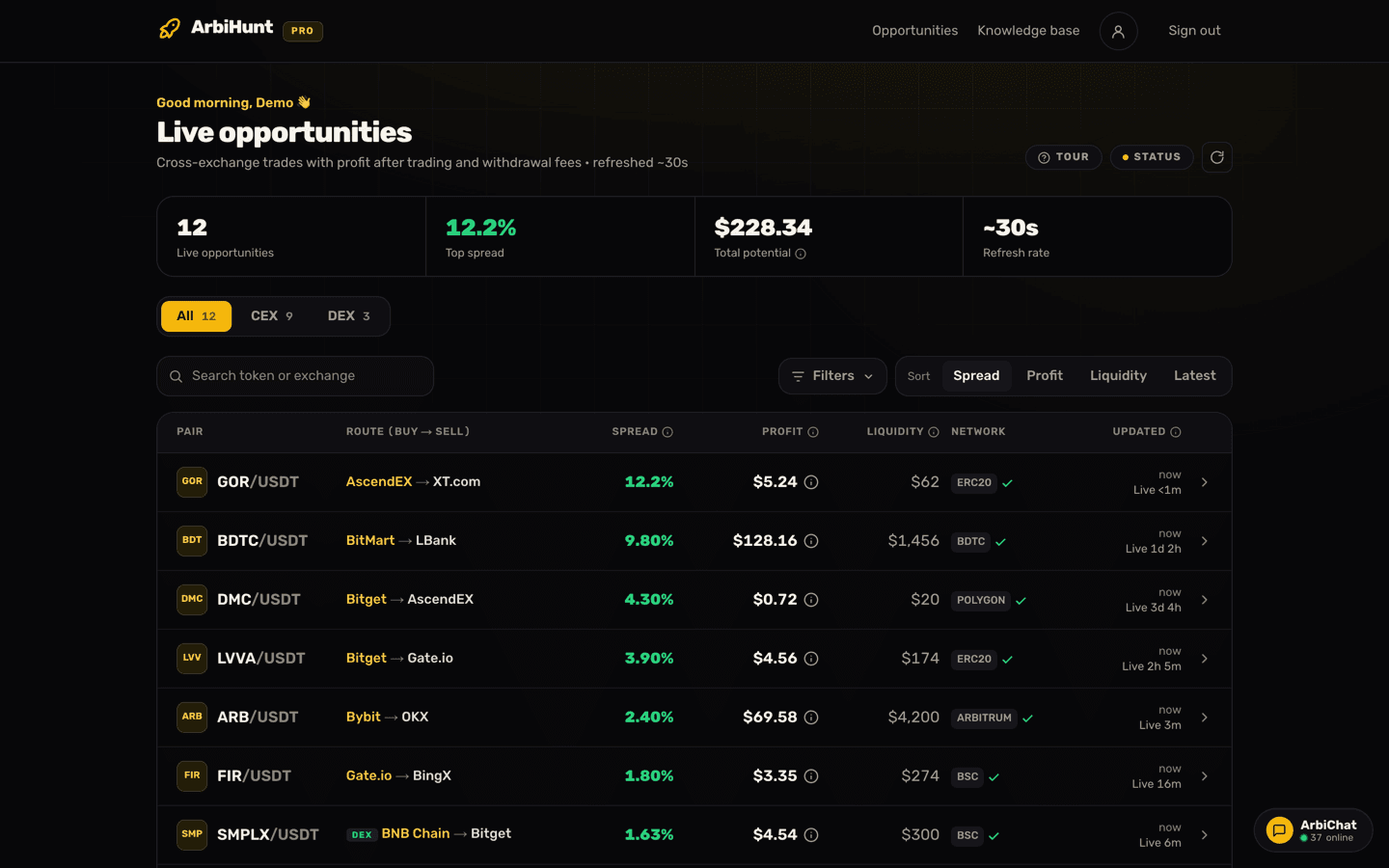
- Read the Route column for a week. Every row shows "buy venue → sell venue", and that route stays visible on a free account even where the coin name is masked. Note which names keep turning up.
- Add the venue that appears most often, not the one with the biggest headline spread. Twenty routes a week beats one spectacular row.
- Revisit every few months. Listings change and venues get paused.
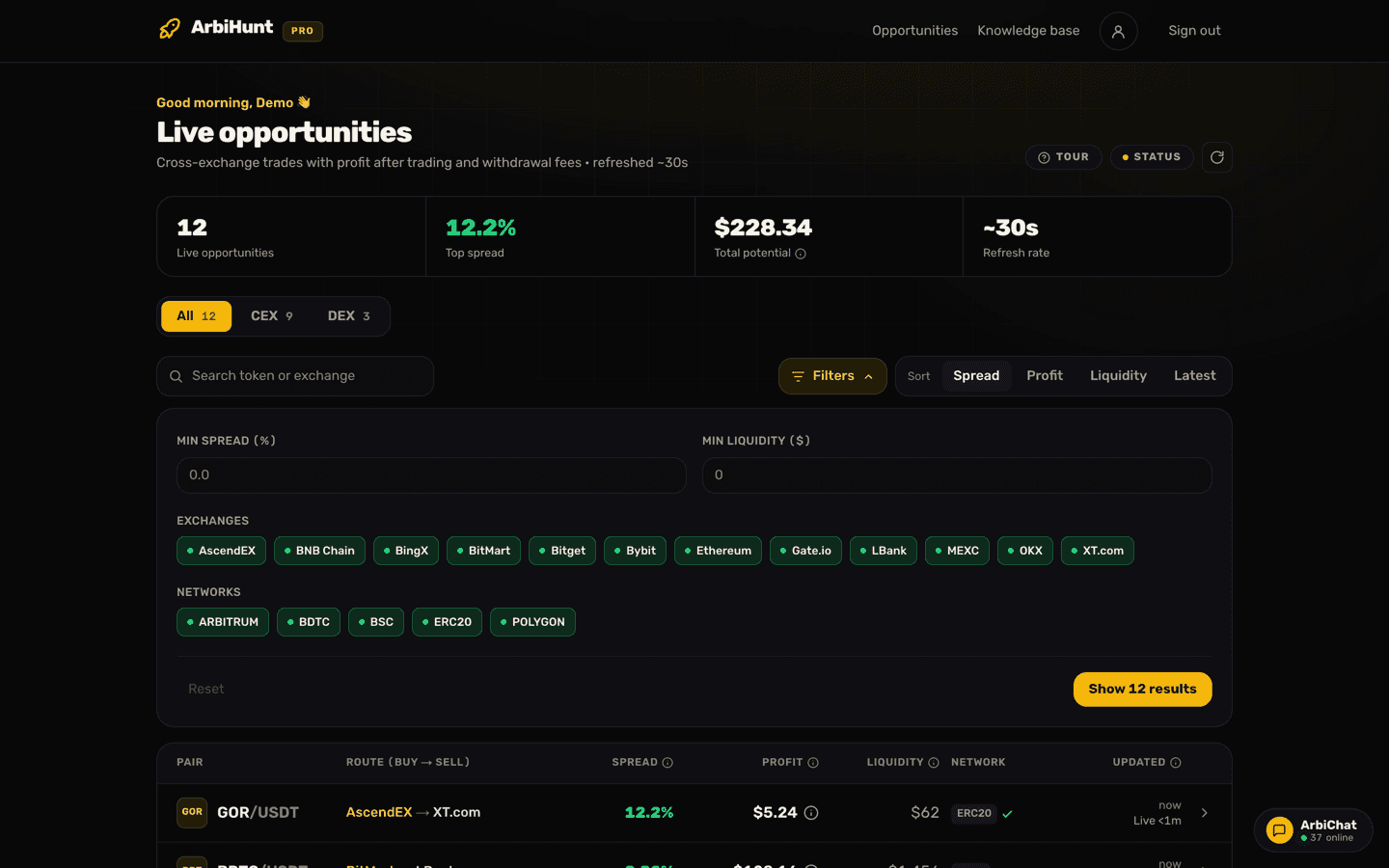
Two things make step 2 easier. The search box in the dashboard toolbar is not PRO-gated and matches exchange names as well as tokens, so type a venue and see how much of the board touches it. On PRO, the Filters panel carries a chip per exchange: switch off every venue you have no account with, and what remains is a board you could actually trade.
Full mechanics in Using filters to find the right opportunities.
Let the board build your list
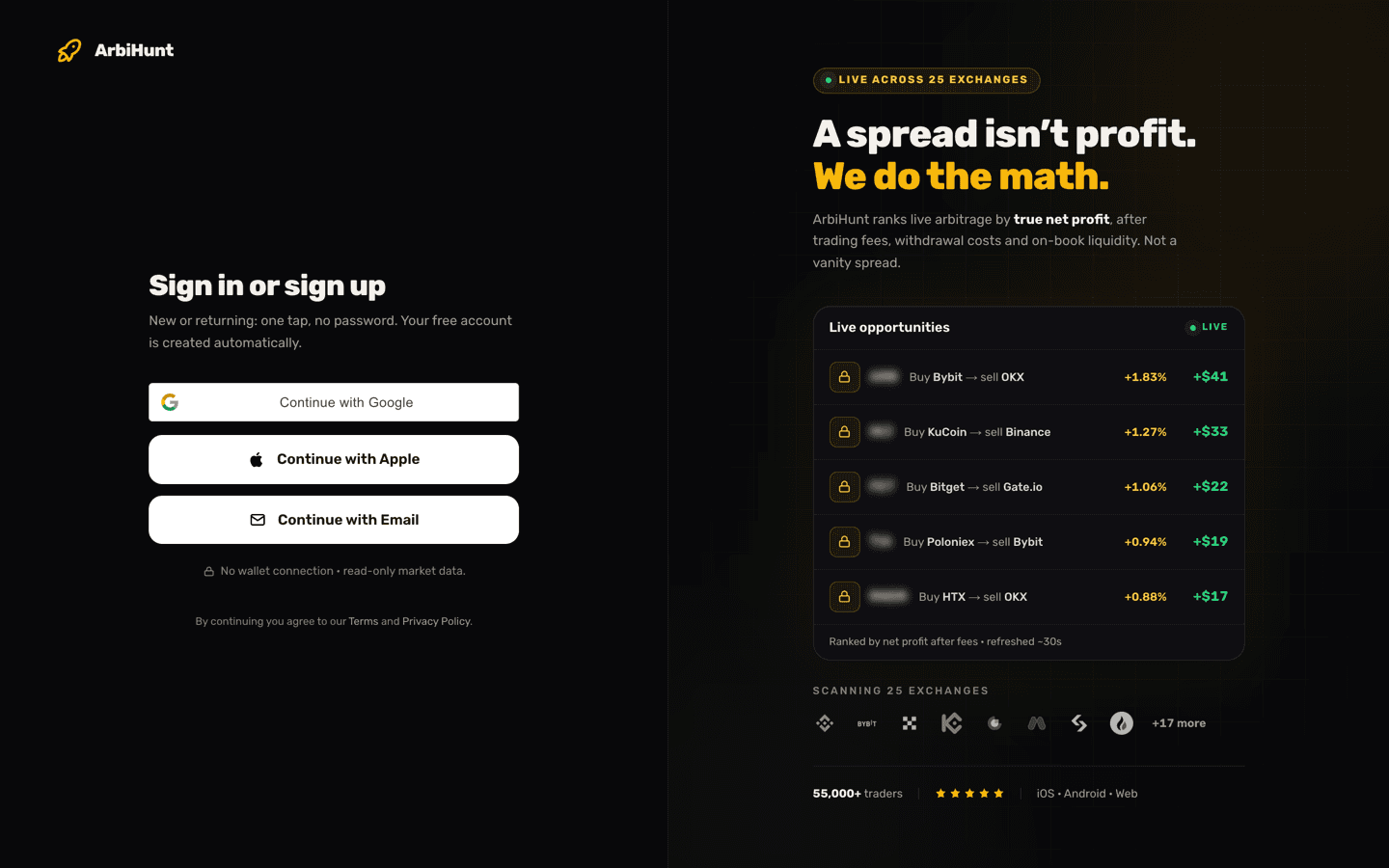
ArbiHunt ranks live spreads across 26 exchanges, each with its profit after every fee, refreshed about every 30 seconds. Watch which venue names keep appearing in the Route column, then open accounts there.
Check the status page before you open an account
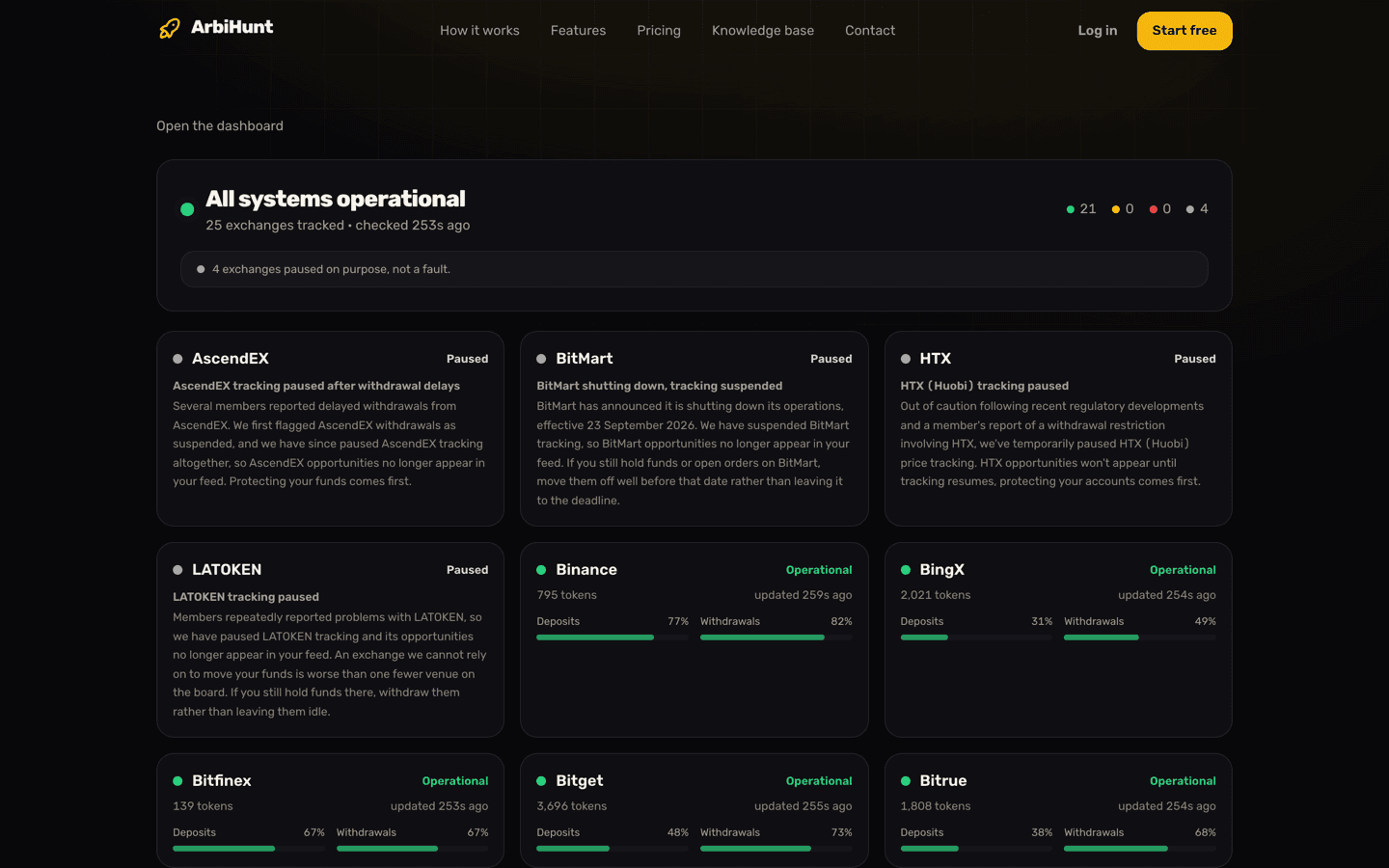
The status page is public: no login, no account. It is the screen captured at the top of this page, and two minutes there beats finding out after a transfer has stalled.
Each card gives three things:
- A health label. Operational, Degraded, Down, Paused or No data. Apart from Paused, these describe how current ArbiHunt's data for that venue is, not a verdict on the exchange. Degraded means data over 15 minutes behind the freshest venue, or no tracked token with withdrawals open; Down means over an hour behind, or older than six hours.
- A token count and a timestamp: how many markets are tracked there, and how recently.
- Deposits and Withdrawals as percentages. This is the number to read: the share of that exchange's tracked tokens whose deposits, or withdrawals, are open right now.
That last one is easy to misread. In that capture, one venue shows 795 tokens with deposits at 77% and withdrawals at 82%; another shows 2,021 tokens at 31% and 49%. The second is not broken: it means that for any given coin there, the odds you can move it in or out are materially worse. For an account whose whole job is moving coins in and out, that gap is the story.
It is one click from the board
The dashboard header carries a STATUS pill, its dot set by overall health, linking to the same page. Free and PRO both get it.
What "Paused" means, and why you should care
A paused exchange is a deliberate stop, not an outage. Tracking halts, its opportunities disappear from the feed on free and PRO alike, and the card drops the health bars to show the reason in plain words.
Paused venues never set the headline either: "All systems operational" can sit above four paused cards, with a separate grey line counting them as paused on purpose, not a fault.
Four of the 25 were paused when this was written, and the reasons are the instructive part: withdrawal delays reported by members; an announced shutdown with a date attached; regulatory developments alongside a reported withdrawal restriction; and repeated reports of problems.
Two things follow. Do not open an account on a paused venue because you remember it producing good spreads, and if you already hold a balance on one, move it off. That is exactly the situation the pause exists to flag.
A lighter version exists: a venue can have its withdrawals flagged as suspended while prices keep flowing. It reads Degraded, withdrawals show Suspended instead of a percentage, and a banner warns you off any route needing a withdrawal from it.
KYC and funding: the lead times that catch people out
The board refreshes about every 30 seconds, and the opportunity detail screen says these spreads typically last no more than a few minutes. Identity verification is measured in hours or days. Those two clocks never meet, so all of this belongs on the calm side of the line.
- Have the documents to hand before you start. An ID and a proof of address cover most flows.
- Complete the highest tier you reasonably can. Tiers usually gate withdrawal limits, and a limit you never checked is a trade you cannot finish.
- Fund the account, then move a small amount back out. Whatever the exchange asks for at withdrawal time, discover it on a $20 test, not with a spread open.
- Treat any quoted verification time as a floor. It varies by exchange, by country and by workload.
Fund both sides before you need to
The naive arbitrage is three steps, buy on A, transfer, sell on B, and the middle step is where the profit goes. Transfers run from minutes to hours, as Deposit and withdrawal times explains, and against a gap that can close at any moment you lose that race more often than you win it.
Hold working capital on both sides instead: a stablecoin balance where you expect to buy, coin where you expect to sell. Then you buy and sell within moments of each other and rebalance later, on your own schedule.
The arithmetic is worth doing once. Take a $1,000 buy on a 1.8% spread with a 0.1% taker fee on each leg:
- Buy $1,000 of the coin, taker fee $1.00.
- Sell it for $1,018, taker fee $1.02.
- Gross spread $18.00 minus $2.02 in fees leaves about $16.
That $16 is before the coin moves. Rebalance over a network charging $1.50 and you keep about $14.50. ArbiHunt's Profit column does the whole of that arithmetic: it is sized to the liquidity actually on the book rather than to a figure you picked, and it takes off the withdrawal fee on the cheapest network open on both sides, because moving the coin between the venues costs that fee whether you do it during the trade or when you rebalance later.
Now shrink the trade to $200 at the same spread: gross $3.60, taker fees $0.40, $3.20 left, and that flat $1.50 takes 47% of it. Spread vs. net profit walks the whole cost stack.
Pre-funding does not delete the transfer fee, it takes it out of the race. You still pay it when you rebalance, but once, in size, on a cheap network, at a moment you choose.
The trade-off is real: capital parked across six venues is exposed to six counterparties and earns nothing while it waits. The four paused exchanges above are that risk with names attached. The risks of crypto arbitrage is the honest list.
Lock the accounts down
There is nothing to connect
ArbiHunt never logs into your exchanges, never asks for API keys, never holds your funds and never places a trade. There is no exchange connection to set up, and no message from us will ever ask for a key, a seed phrase or a password.
- Use an authenticator app (TOTP) rather than SMS where the exchange offers it: SIM-swap attacks make SMS the weaker option.
- Save the backup and recovery codes offline.
- Turn on a withdrawal-address allowlist if available, and do it early: exchanges commonly impose a waiting period before a newly added address can be used.
The checks that are per-trade, not per-account
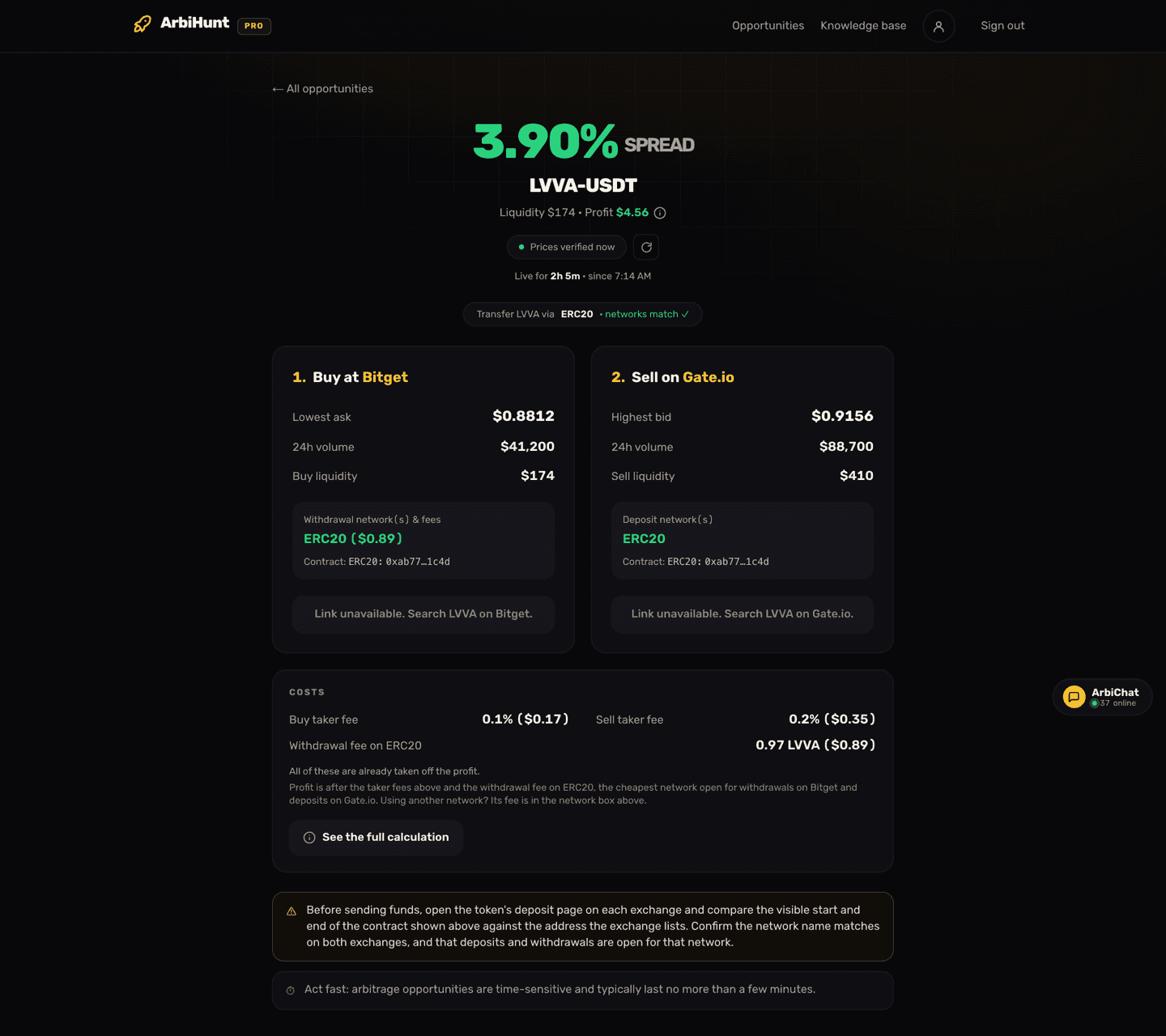
Account setup gets you to the starting line. Each opportunity still needs three checks, and the detail screen is built around them: withdrawal network and fee on the buy leg, deposit networks on the sell leg, and a "networks match" pill when both venues share one.
- The network is supported on both sides. You must withdraw over a chain the receiving exchange credits for that coin; send on one it does not and the funds can be lost. See Choosing the right network for a transfer.
- The contract matches. ArbiHunt shows the contract address per exchange to PRO accounts, on both legs. Compare its visible start and end characters against each exchange's own deposit page.
- Deposits and withdrawals are open for that coin and network right now. The status percentage is an exchange-level average, not a promise about your coin; only the exchange's deposit page settles that, in the moment.
Same ticker is not the same coin
The same symbol can be a different, migrated or wrapped contract on another exchange. Confirm the contracts match on both venues before you move anything.
The setup checklist
| Step | Why it matters |
|---|---|
| Accounts on both legs of a route | One out of two is zero |
| Venues chosen from your own board | Beats any ranking, including one we could write |
| Status page checked before signup | Deposit and withdrawal health decides an arbitrage account |
| KYC done at the highest sensible tier | Verification runs in days; spreads run in minutes |
| 2FA and an address allowlist enabled | You are about to hold real balances there |
| Capital pre-held on both sides | Capture the spread without racing a confirmation |
| Network, contract and transfer status re-checked per trade | Conditions change constantly |
Work through that once and the gap between spotting an opportunity and acting on it shrinks to two order placements. When you are ready to run one end to end, read How to execute an arbitrage trade, step by step.
None of this is financial advice. Crypto trading carries risk, spreads close in seconds, and an opportunity on the board may not still be executable by the time you reach it.
See it live
ArbiHunt scans 26 exchanges in real time and ranks every spread by true net profit, after fees, withdrawals and live liquidity.