A member asked us a sharp question: when a coin is cheaper on one exchange than on another, is the buy side undervalued or the sell side overvalued? It matters, because it decides who gets the profit. If the buy price is the odd one out, the profit goes to the first traders who buy, and once they hold the coins they can usually still sell at the normal market price. If the sell price is the odd one out, the profit goes to whoever transfers and sells first, and everyone else arrives too late.
ArbiHunt now answers that question on every trade it can.
The market price
A spread only compares two exchanges: the one you buy on and the one you sell on. To know which of the two is out of line, you need a third opinion.
So ArbiHunt looks at the same coin on the other exchanges that list it, leaving out the two in the trade, and takes a market price from them. Then it measures both sides of the trade against it:
- how far the buy price is below the market price, and
- how far the sell price is above it.
Say a coin trades around $0.9139 on six other exchanges. On Bitget you can buy it at $0.8812, which is 3.58% below the market price. On Gate.io you can sell it at $0.9156, only 0.19% above. Almost the whole gap is on the buy side: Bitget is cheap, and Gate.io is roughly where everyone else is.
Underpriced on the buy side
When the buy exchange is below the market price, the gap comes from an underpriced buy. The board tags the route Underpriced buy on and the name of the buy exchange.
The first buyers take the profit. An underpriced price is only a handful of sell orders sitting below where the coin trades everywhere else, and there is only so much of the coin at that price. The first traders to buy take those orders, and once they are gone the buy exchange's price climbs back to the market price.
The gap can vanish from the board, and your trade is still on. ArbiHunt measures the gap from the prices on the exchanges right now. After the cheap orders are bought, the two exchanges are back in line, so the route may drop off the board on the next scan. That does not undo your trade. You already hold coins you paid less for than the rest of the market, and the exchange you sell on was trading close to the market price all along. Its price did not depend on the cheap orders, so it is usually still there when your transfer lands.
What can still go wrong:
- You are not first. If others clear the cheap orders before you, you buy at the market price and there is no gap left to sell into. Check the buy price on the exchange before you place the order.
- The whole market moves. While your coins are in transit, the coin can fall everywhere, including on the sell exchange. That is the ordinary transfer risk every arbitrage carries, not something the gap itself causes.
- The transfer is slow or closed. A network that stalls or an exchange that pauses deposits leaves you holding the coin longer. See how long deposits and withdrawals take.
In short: the hurry is on the buy. Once the buy is done, the rest of the trade is a normal transfer.
Overpriced on the sell side
When the sell exchange is above the market price, the gap comes from an overpriced sell. The board tags the route Overpriced sell on and the name of the sell exchange.
It is a race to sell first. The whole gap lives in a few buy orders on the sell exchange that pay more than any other exchange. Everyone who sees them can buy the coin at the market price elsewhere, so the buy side gives nobody an edge. What decides the trade is who gets coins onto the sell exchange and fills those orders first. Once they are filled, or the price falls back to the market, the gap is gone.
That makes the transfer the whole contest. Your coins have to leave the buy exchange, confirm on the chain and credit on the sell exchange, which can take minutes (see how long deposits and withdrawals take). You may also be racing traders who already keep the coin on the sell exchange and can sell the moment the price appears, with no transfer at all.
If you arrive after the gap has closed, you are left holding coins you bought at the market price and can only sell at the market price, so the fees make it a small loss. On these routes, pick the fastest network the two exchanges share, and skip the trade if the transfer is slow.
Both sides
Sometimes the buy exchange is below the market price and the sell exchange is above it, each by a meaningful amount. The board tags those routes Both sides. Buying first secures the part of the profit that comes from the cheap buy. The part that comes from the high sale is still a race, as above, so plan the trade as if the sale has to be fast.
Who gets the profit
The spread tells you how big a gap is. Where it comes from tells you who gets it:
| Where the gap comes from | Who gets the profit | Where the hurry is |
|---|---|---|
| Underpriced buy | The first to buy | The buy. After that, a normal transfer |
| Overpriced sell | The first to transfer and sell | The transfer and the sale |
| Both sides | Part to the first buyers, the rest to the first sellers | Both. Treat the sale as a race |
It is one input, not a verdict. Liquidity, fees and the transfer network still decide whether a trade pays at all: see spread vs. net profit.
When only one other exchange lists the coin
A market price needs a market, and the more exchanges it comes from, the better. ArbiHunt names a side when at least 1 other exchange has a usable price for the coin, beyond the two in the trade. With only one, that one price is the market price, and the opportunity page says so: from only 1 other exchange. Treat it as a thinner read, since a single exchange can be out of line itself.
When only the two exchanges in the trade list the coin
Many small coins trade on just two of the exchanges ArbiHunt scans, which is also where many of the biggest spreads appear. There is no third price to compare with, so ArbiHunt asks a different question: which of the two prices moved to open the gap?
It keeps each exchange's recent prices for these coins and compares where each one is now with where it traded over the previous 15 minutes:
- If the buy exchange fell while the sell exchange held steady, the gap comes from an underpriced buy.
- If the sell exchange rose while the buy exchange held steady, it comes from an overpriced sell.
- If both moved apart, it is both sides.
The opportunity page then says, for example: Only these 2 exchanges list this coin, so ArbiHunt looked at which price moved. In the 15 minutes before the gap appeared, Gate.io rose 5.76% and Binance held steady.
The bigger market leads. The price that moved is not always the odd one out. When the exchange that moved trades 3 times the other's volume or more, it is the bigger market, and it is more likely the coin really moved there while the smaller exchange has not caught up. Then the smaller exchange is the price out of line, and the tag names it. The page adds a line such as Binance trades far more, so the price out of line is on LBank.
The answer is taken once, when the gap appears, and kept while the same route stays on the board: it describes how this gap opened.
When ArbiHunt still cannot tell
The tag stays off, and the opportunity page says it cannot tell, when:
- no other exchange has a usable price and neither price moved enough in the last 15 minutes to explain most of the gap. The gap was already there before, so the recent moves say nothing about who opened it;
- the exchange that moved is the bigger market, but by less than 3 times the volume. Either price could be the one that gives way, and a wrong call here would matter most;
- ArbiHunt has only just started watching the coin, for example in the first minutes after an update.
A snapshot, like every number on the board
The market price is taken from other exchanges' prices at the moment of the scan. A thin market elsewhere can move it, and a news event can move all of them at once. Re-check the prices on the exchanges before you trade.
Where you see it
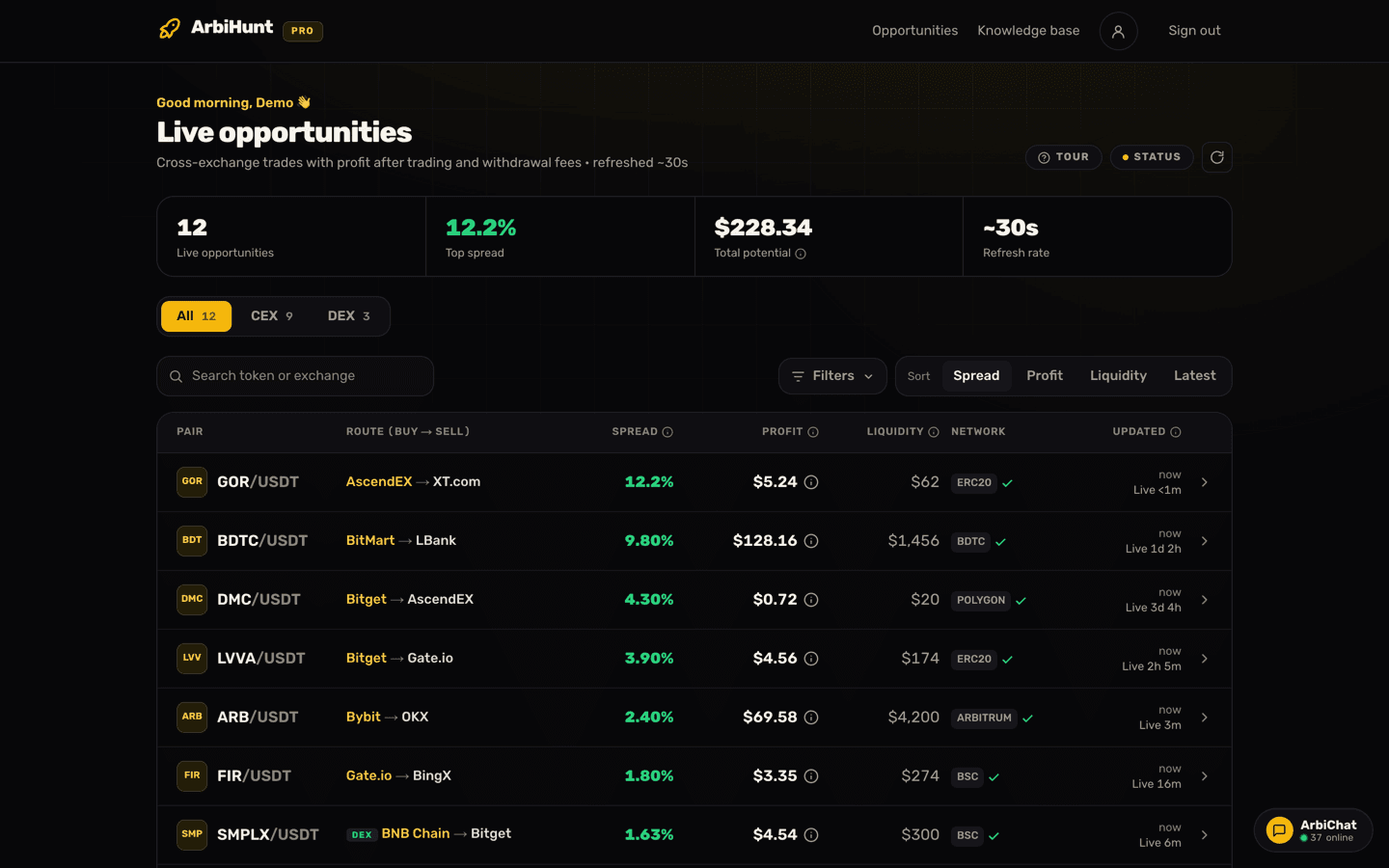
- On the board: a small tag under the route, Underpriced buy on MEXC, Overpriced sell on Gate.io or Both sides. No tag means ArbiHunt could not tell, or has not measured that trade yet.
- On the opportunity page: a Where the gap comes from card under the two prices, with the market price, how many other exchanges it came from, how far each side is from it, and one line on who gets the profit: the first to buy, or the first to sell.
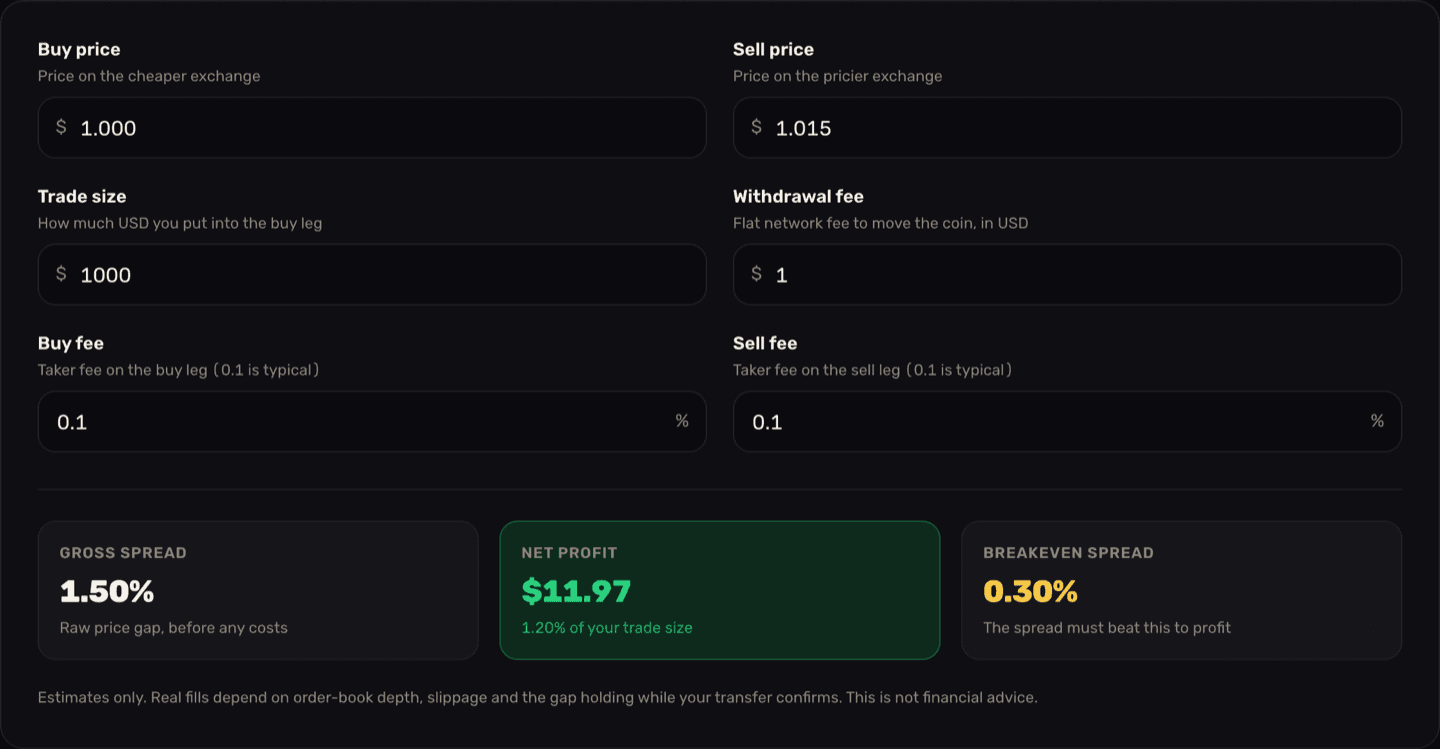
- In the calculation: PRO members see the same card at the bottom of the (i) beside the profit.
Free until Oct 11, then PRO
Where the gap comes from is free for everyone until October 11, 2026. After that it becomes part of PRO: free accounts see a PRO lock where the tag would be, and the card on the opportunity page asks to unlock it. See what Free and PRO each show.
Know which side of the gap to hurry
PRO shows where every gap comes from, underpriced buy or overpriced sell, next to the profit after every fee, so you know before you start whether the profit goes to the first buyer or the first seller.
ArbiHunt never connects to your exchange accounts, never holds funds and never places an order. It is an information tool; you make every trade yourself. Nothing here is financial advice, and crypto trading carries real risk of loss.
See it live
ArbiHunt scans 26 exchanges in real time and ranks every spread by true net profit, after fees, withdrawals and live liquidity.