Liquidity is how much of a coin you can buy or sell near its current price before the price moves against you. A liquid market has lots of orders close to the price, so a big trade barely moves it. A thin market has few, so even a small trade pushes the price up as you buy or down as you sell.
On ArbiHunt, every trade shows a Liquidity figure in dollars. Members often read it as the amount they are supposed to trade. It is not. It is a ceiling: the most you could move before the gap disappears into your own order. You can trade any amount under it.
Liquidity lives in the order book
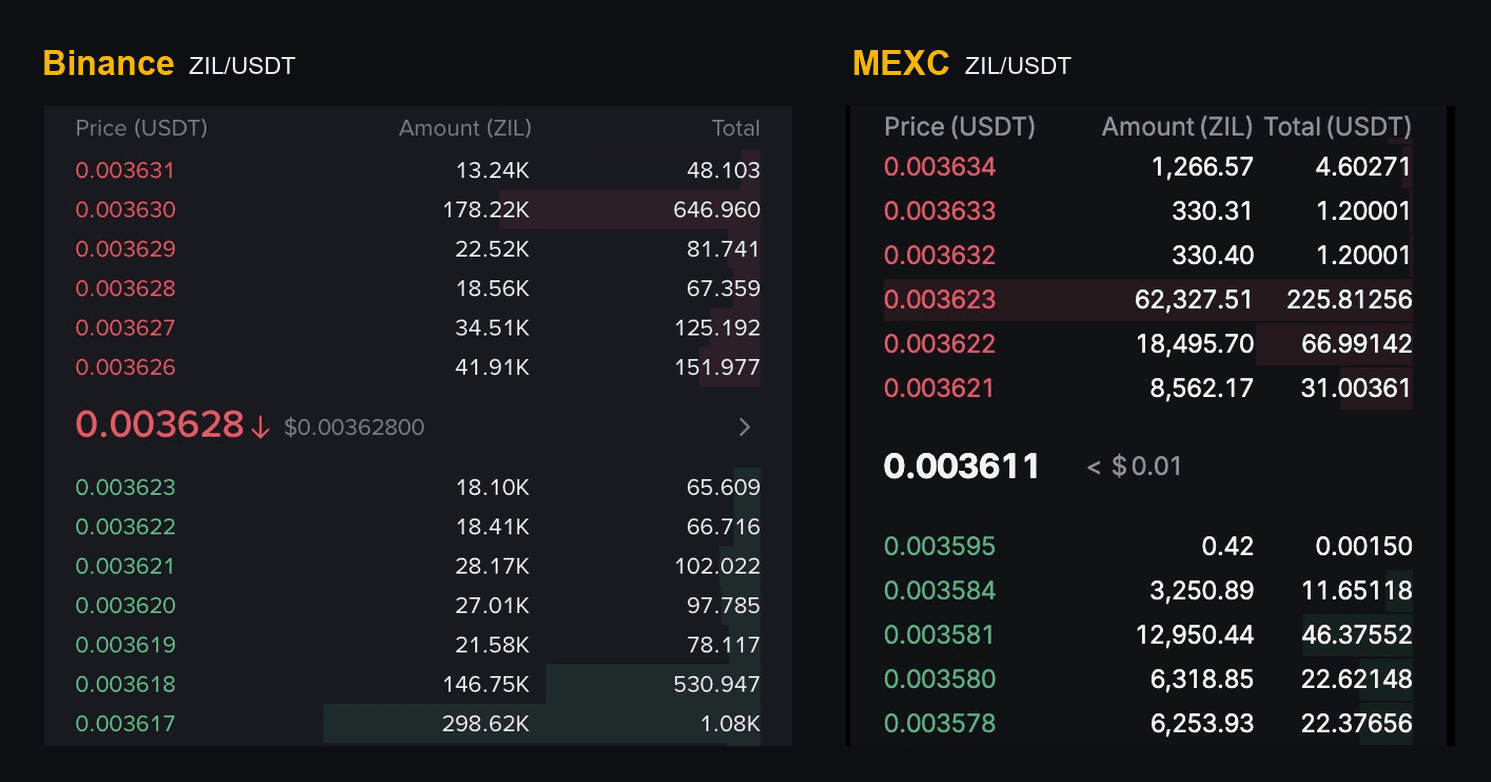
An exchange's order book lists every offer waiting to be filled: asks from people selling, bids from people buying. Liquidity is how much sits near the top of each side.
Two books for the same coin at the same moment can be worlds apart. In the example in how to read a crypto order book, the same coin had about ten times as much waiting on Binance as on MEXC. A $500 buy barely moved the price on one and cost several times more slippage on the other.
Two signs of a liquid market:
- A tight spread between the best ask and the best bid.
- Real size at the top rows, not a token amount at the best price with the real orders further away.
Liquidity is not volume
24-hour volume is how much traded over the last day. Liquidity is how much you can trade right now, near the price. A coin can show millions in volume and still have $200 waiting near the price at this moment, because volume is history and liquidity is the present. Some exchanges' volume figures are also inflated. When you size a trade, the order book is what counts.
How ArbiHunt measures it
For each trade, ArbiHunt looks at both order books:
- on the buy exchange, the asks you would buy from;
- on the sell exchange, the bids you would sell into.
On each side it adds up the orders within a short distance of the best price: 80% of the trade's spread, and never less than 0.5%. Orders further out are left out, because buying that deep would eat most of the gap. Then it takes the smaller of the two sides. A trade can only be as big as its thinner leg: $5,000 of asks on the buy side does not help if the sell side holds $300 of bids.
That smaller number is the Liquidity on the row and on the trade page.
Liquidity, Capital and profit
The trade page shows three numbers that belong together:
| Figure | What it means |
|---|---|
| Liquidity | The most you could move near the price, on the thinner side |
| Capital | The trade size the profit was worked out at: the size that makes the most profit |
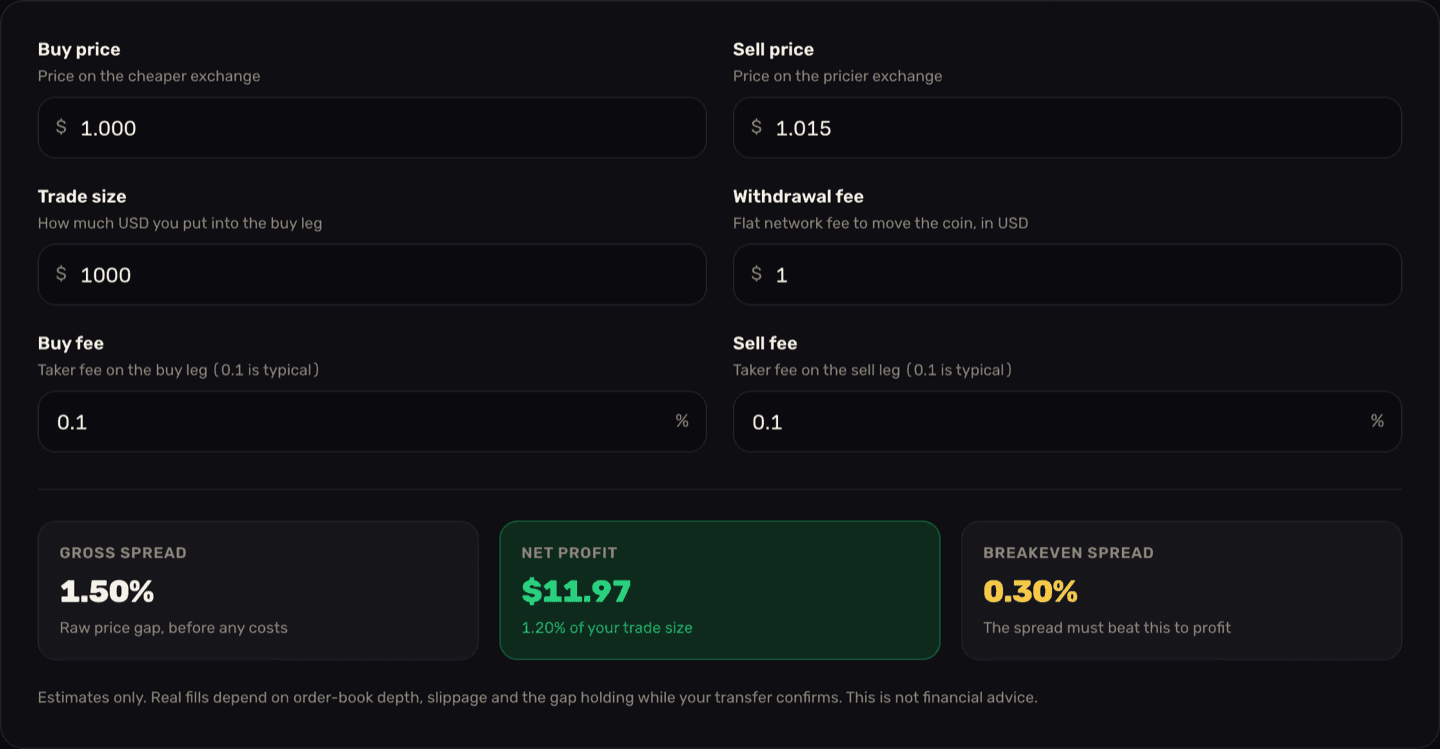
| Profit | What the trade leaves at that size, after both taker fees and the withdrawal fee |
Liquidity is what the books hold near the price; Capital is how much of it is worth using. The deeper you go into a book, the worse each extra dollar gets, and at some point another dollar of trade costs more in price than it earns in gap.
Do I have to trade the full amount?
No. You can trade less than Capital, and most people do. Two things change when you do:
- The profit shrinks roughly in line with the size, and your average prices get a little better, because a smaller order stays on the best rows.
- The withdrawal fee does not shrink. It is a flat amount per transfer, so it takes a bigger share of a smaller trade.
Say a trade shows Capital $600 and profit $9.20, with 0.1% taker fees on each side and a $1.00 withdrawal fee. At $600 that is about $11.40 of gap, $1.20 of trading fees and $1.00 of withdrawal fee. Trade $200 instead:
| At $600 | At $200 | |
|---|---|---|
| Gap captured | $11.40 | about $3.80 |
| Taker fees, both sides | $1.20 | $0.40 |
| Withdrawal fee | $1.00 | $1.00 |
| Profit | $9.20 | about $2.40 |
A third of the size, about a quarter of the profit, and a little more in practice because of the better prices. The free arbitrage calculator does this sum at your own size, including the smallest spread that still pays.
What about trading more than the Liquidity?
You can, but past that point you are buying from offers far above the best price, or selling into bids far below it, and the gap is gone. On thin coins the book can also change between ArbiHunt's check and your order: a large order sitting near the price can be cancelled in a second. Treat the Liquidity figure as an upper limit, and open the real order book before a large trade.
Liquidity on a DEX
A decentralized exchange has no order book. You trade against a pool of two coins, and the bigger the pool, the less your swap moves the price. On a DEX trade, ArbiHunt's Liquidity is the smaller of the exchange's order book near its best price and the largest swap that still pays. Setting up a wallet for DEX trades covers swaps, gas and slippage.
Using liquidity on ArbiHunt
- PRO members can filter the board by minimum liquidity, and sort by it, so the board only shows trades big enough to be worth a transfer. Using filters to find opportunities shows how.
- Every member sees the Liquidity on every row, free or PRO.
- A very wide spread with little liquidity behind it is the most common trap on the board: big percentage, few dollars. Read the two together.
Not financial advice
Liquidity and profit are measured from order books seconds before you see them, and books change fast. Check the order book on both exchanges before you trade, and size the trade to what you can afford to have stuck in a transfer.
See it live
ArbiHunt scans 29 exchanges in real time and ranks every spread by true net profit, after fees, withdrawals and live liquidity.